


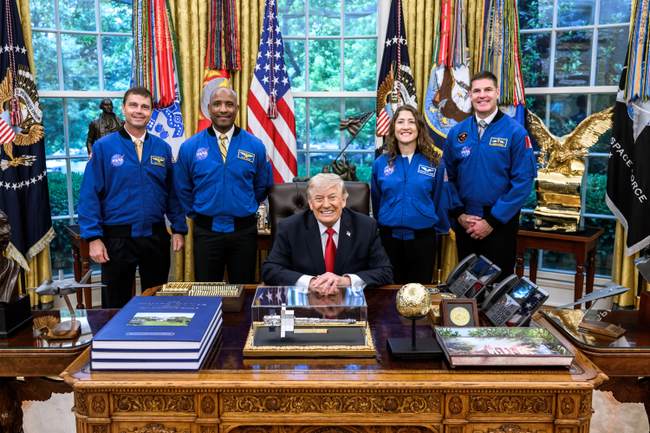
America is going back to the Moon. China wants to get there first. On Tuesday, NASA put four names on the answer.
Andre Douglas
Luca Parmitano
Randy Bresnik
Frank RubioARTEMIS III. 2027. 🚀🌙 pic.twitter.com/2TnKCqkpcb
— The White House (@WhiteHouse) June 9, 2026
Advertisement
At Johnson Space Center in Houston, NASA named the crew that will fly Artemis III, the mission that bridges last April’s historic lunar flyby and a planned boot-on-the-moon landing in 2028. Three Americans and one European will fly the Orion spacecraft in 2027 on what NASA is calling one of the most complex missions it has ever attempted. Astronaut Bob Hines was named backup.
Two months ago, Artemis II carried four astronauts around the Moon for the first time in more than 50 years. Americans watched it happen under this administration. Tuesday, the next crew got their names called.
That crew announcement came from Jared Isaacman, the NASA administrator who scrapped the previous Artemis III plan earlier this year after concluding it was moving too fast with too little preparation. “We didn’t go right to Apollo 11,” he said at the time. “We had a whole Mercury Program, Gemini, lots of Apollo missions before we ultimately landed.” The old plan, he said flatly, “was not a pathway to success.” This mission is the corrected course.
Isaacman said Tuesday:
“Today we take another bold step in humanity’s return to the Moon, building on the extraordinary foundation laid by the Artemis II astronauts. Their achievements reignited global excitement for exploration, and now they pass the torch to the Artemis III team, Randy, Luca, Frank, and Andre. Artemis III will demonstrate the power of American innovation and international partnership as we test complex rendezvous and docking operations and advance the technologies that will one day carry us deeper into the solar system.”
Advertisement
This is not a repeat of Artemis II. Where that mission flew around the Moon, Artemis III stays in low Earth orbit to tackle something harder: docking the Orion spacecraft with two separate commercial lunar landers, both built by American companies: Blue Origin and SpaceX. Getting that procedure right is what stands between now and Americans walking on the Moon again, before China gets the chance to plant its flag there first.
WATCH: @NASAAdmin announces the crew of Artemis III, a historic mission set to launch next year, which will demonstrate critical systems needed for future lunar landings. 🚀🌕 pic.twitter.com/A0AUo4QkT1
— Rapid Response 47 (@RapidResponse47) June 9, 2026
NASA Flight Operations Director Norm Knight did not undersell it:
“This mission will be one of the most complex that NASA has undertaken.”
Over two weeks in orbit, the crew will test docking hardware, life-support systems, communications, and propulsion technologies that can only be evaluated in space. If it works, Artemis IV lands on the lunar surface in 2028.
The four men carrying that responsibility have earned it.
Commander Randy Bresnik is a retired Marine Corps colonel, F/A-18 test pilot, and veteran of two spaceflights with more than 7,000 flight hours. He spent years embedded in the Artemis program helping design the very mission he will now command.
Read More: The Artemis II Heroes Are Back Home, but the Mission Goes On. What’s Next?
THE ESSEX FILES: Artemis II Success Sets Stage for Renewed American Leadership in Space
Advertisement
Pilot Luca Parmitano is an Italian Air Force colonel and a NATO ally who once kept his composure as his spacesuit helmet filled with water during a spacewalk and brought himself safely back to the airlock. He has flown six spacewalks and commanded the International Space Station.
Mission Specialist Frank Rubio set the American record for the longest single spaceflight at 371 days in orbit, an endurance feat born from a Soyuz malfunction that kept him in space far beyond his original mission.
Mission Specialist Andre Douglas, a Coast Guard Reserve commander with a Ph.D. in engineering, trained as the backup for Artemis II and will make his first trip to space.
When Douglas learned Tuesday that he had made the crew, he said:
“My brain, it is going a mile a minute right now. But my heart, my heart, it is so warm. It is so full.”
Training begins now. In roughly a year, these four men will lift off on a mission that clears the last technical hurdles before Americans return to the lunar surface for the first time since 1972.
Editor’s Note: Do you enjoy RedState’s conservative reporting that takes on the radical left and woke media? Support our work so that we can continue to bring you the truth.
Join RedState VIP and use promo code FIGHT to receive 60% off your membership.