


On the morning of January 16, 2025, hundreds of Colombian rebels, some who invaded from Venezuela, launched an offensive to wipe out a rival group. At least 80 people were killed, and over 50,000 fled their homes in terror.
Many of the invading force were uniformed and bore the red and black armbands of the National Liberation Army (Ejército de Liberación Nacional – ELN). There was no declaration of war on their one-time allies of the 33rd Front, a dissident faction of the now-defunct Revolutionary Armed Forces of Colombia (Fuerzas Armadas Revolucionarias de Colombia – FARC). The FARC dissidents were taken totally by surprise in their strongholds in the Catatumbo region of Norte de Santander.

*This article is the first in a five-part investigation, “Peace Never Had a Chance: Colombia’s ELN in Venezuela,” analyzing the growth of the ELN in Venezuela and how this has allowed the rebel group to project itself into Colombia. Read the full investigation here.
According to the ELN, the armed offensive was triggered by the 33rd Front’s murder of Miguel Ángel López, his wife, and their 9-month-old baby the day before. López, a gravedigger in the municipality of Tibú, was well known in the area and often had to interact with the armed groups to cross invisible front lines and retrieve bodies. He was allegedly killed for violating the rules established by the illegal actors in this, one of Colombia’s top cocaine-producing regions.
“On January 15, dissident groups killed a family in Tibú, killing the parents, a newborn child, and wounding another child. This vile act, which was blamed on the ELN, was the last straw,” read an ELN communique signed by Israel Ramírez Pineda, alias “Pablo Betran,” one of the ELN Central Command (COCE).
Except the ELN operation had been weeks, if not months, in the planning. The murder of López was just a pretext for the long-held ELN plan to establish hegemony over Catatumbo.
Over the next few weeks, the ELN’s advance resulted in burned houses, confined communities, and civilian casualties, as it sought to expel the rival guerrillas. By March, the ELN had seized 90% of the territory previously controlled by the 33rd Front in Catatumbo, according to a report by the Ideas for Peace Foundation (Fundación Ideas para la Paz – FIP).
The ELN even targeted social leaders not loyal to the FARC dissidents.
A popular social leader from Catatumbo named José del Carmen Abril posted on social media about the alleged harassment he faced in January.
“I fear for my life because they’ve come to my house to look for me four times,” he said in a video recorded hours before he was detained by the ELN. “They are killing ex-combatants left and right.”
SEE ALSO: Renewed War for Colombia Cocaine Center
Between January and early May 2025, the ELN offensive left 117 people dead, including civilians, social leaders, and demobilized FARC members.
The ELN offensive was also the last straw for the peace process with the government of President Gustavo Petro. Following the Catatumbo incident, the Colombian government suspended dialogue with the ELN, leaving a rift that is still unmended. And with presidential elections next year, it likely dealt a death blow to the chances of any peace agreement being signed by this government, and perhaps the one to follow.
Though the offensive occurred on Colombian soil, a Colombian intelligence source said that up to 200 rebels invaded FARC dissident territory from Venezuela. Such a movement could not have occurred without the toleration, if not outright blessing, of elements of the regime of Venezuelan President Nicolás Maduro.
Three of the ELN’s five main fighting divisions, or War Fronts (Frentes de Guerra), are based in Venezuela. The guerrillas of the ELN’s Northeastern War Front, responsible for Catatumbo, were able to count on reinforcements of hundreds of combatants from the Eastern War Front based in the Colombian department of Arauca and the Venezuelan state of Apure.
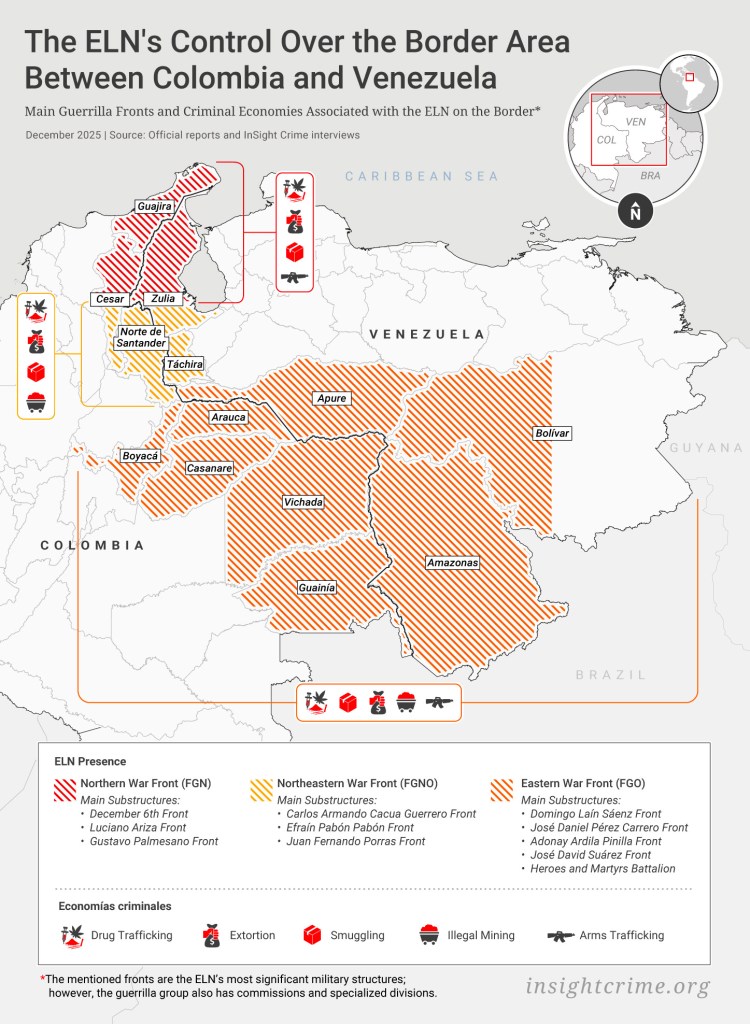
But rather than crossing Colombian territory to reach Catatumbo, the Eastern War Front traveled through Venezuela’s border municipalities. According to border residents who spoke to InSight Crime anonymously for security reasons, there are well-trodden rebel access routes and greater ease of movement through Venezuelan territory. In addition to providing logistical advantages, crossing Venezuela allowed the ELN guerrillas to avoid detection by Colombian authorities.
Colombian officials, including President Gustavo Petro, stated publicly in January that the ELN troops had come through Venezuelan territory from Arauca. The ELN denied it but left open the possibility of future troop movements.
“Until now, no commander or fighter has been moved from Arauca to Catatumbo. It has not been necessary. But when other types of threats arise, the ELN troops are national, and the Central Command has the mandate and authority to make such decisions,” Pablo Beltran added in his statement.
One of the most practical routes begins at the crossing to El Nula, a town in the Venezuelan state of Apure, from where it leads to San Cristóbal, the capital of the state of Táchira. From there, it continues to La Fría, also in Táchira, and connects to southern Zulia, which leads to the Catatumbo area in Colombia’s Norte de Santander department.
SEE ALSO: Major Criminal Powers Dispute Key Corridors in Colombia
The ELN’s military presence in Venezuela goes well beyond movement corridors. Guerrilla camps on the Venezuelan side of the border offer specialized training in the use of drones and snipers, according to local residents interviewed by InSight Crime and intelligence reports cited by El Tiempo.
Reportedly counting on the support of Venezuelan military personnel, guerrillas have set up facilities where they assemble and modify drones while experimenting and planning drone attacks. The use of drones has marked a shift in the military tactics of the ELN. These devices allow for precision attacks without putting fighters at risk.
Yet Venezuelan involvement in the offensive against the 33rd Front was more direct still. On January 31, a fortnight after the first ELN attacks, the Bolivarian National Armed Forces (Fuerza Armada Nacional Bolivariana – FANB) launched Operation Catatumbo Lightning. Although it was officially presented as an effort to expel foreign armed groups from the country, the troops focused on attacking the 33rd Front’s presence in Venezuela, while leaving the ELN alone.
Catatumbo: A Rebel ATM
The 11 municipalities of Catatumbo are home to 55,000 hectares of coca, which can produce anything up to 400 tons of cocaine. In Colombia, a kilo of cocaine sells for $1,500, which means cocaine production in Catatumbo can generate $600 million a year. The average international wholesale price of cocaine is $25,000, meaning that Catatumbo’s production, once exported, is worth up to $10 billion.
Catatumbo is key to the funding of the ELN. The income generated from this region could keep the ELN funded at current levels for eternity. The region is home not only to vast fields of coca but also to cocaine laboratories and clandestine airstrips.
The January 2025 offensive was just the latest effort by the ELN to establish complete control over Catatumbo. In 2018, it attacked its former allies of the Popular Liberation Army (Ejército Popular de Liberación – EPL) in Catatumbo.
The EPL, now extinct, was another insurgent group with roots going back to the 1960s. Working with the FARC dissidents of the 33rd Front, the ELN cornered the EPL, crushed it, and expelled the remnants from Catatumbo. Now it was the turn of the 33rd Front to be betrayed by the ELN.
The Strategy for Hegemony Along the Colombia-Venezuela Border
Yet the Catatumbo offensive is just one chapter in the ELN’s ambition to do something no illegal actors have achieved during Colombia’s six-decade-old civil conflict: establish hegemony along the frontier with Venezuela.
There are several ways it is achieving this. The principal one is through its relationship with the Maduro regime, expanding its presence in Venezuela and using it to project itself into Colombia. The ELN has forged a strategic alliance with the Maduro regime, a symbiotic relationship. It is likely no coincidence that the ELN offensive in Catatumbo came just days after Maduro was sworn in for another six-year term as president, having stolen the presidential elections last year.
The ELN-Maduro relationship is built around three pillars. The first is an ideological affinity with the Bolivarian Revolution set up by Hugo Chávez. This predates Maduro but remains relevant today. The Marxist Leninist ELN, born in Cuba, and the socialism of the Bolivarian Revolution hark back to a long-ended Cold War.
The second pillar is access to criminal rents. Faced with economic collapse, hyperinflation, international sanctions, and isolation, Maduro has come to rely on access to illicit economies to keep his generals and senior politicians loyal. Unable to pay senior regime figures a decent wage — and what is paid doled out in worthless bolivars — Maduro has set up a system whereby he posts generals, or senior regime figures, to areas of the country where there is access to smuggling, drug trafficking, or gold mining. This system InSight Crime has defined as a hybrid criminal state.
The Venezuelan states that border Colombia are where these criminal economies abound and where the ELN has set up shop. Born in Cuba, the ELN still retains strong ties with Havana, a close ally of Maduro. Indeed, many military sources in Venezuela have told InSight Crime over the years that it is the Cuban intelligence services that monitor the Venezuelan military and have headed off dissent through arrests and intimidation. So perhaps it is no surprise that Maduro trusts the ELN as much, if not more, than his own military. This system of hybrid criminal governance has seen relations between the ELN and regime figures deepen. And it has ensured that Maduro has come to increasingly rely on the ELN to help keep him in power.
The last pillar in this symbiotic relationship, more relevant today than ever before, is the fact that the ELN provides a deterrent to any military action against Venezuela. This was initially envisioned as a buttress against Colombia, which has had a stormy relationship with Venezuela over the last two decades and which was, until recently, Washington’s most longstanding and dedicated ally.
“The ELN has become one of the lines of defense of the Maduro regime; it is no longer just a partner in terms of the organized crime that governs within Venezuela, but is part of the entire defense strategy that Maduro intends to carry out, in case any military action occurs for political change,” insists Julio Borges, an opposition politician and formerly president of the National Assembly, who now lives in exile in Spain.
This has become particularly relevant as the United States lines up a naval flotilla off the Venezuelan coast and drills marines and special forces. While the Venezuelan military’s dated Russian equipment will provide little resistance to US airstrikes, the threat of asymmetric warfare is real, and the US military know that the ELN are a formidable foe, having seen them defy the US-backed Colombian military for decades.
This support from Maduro has allowed the ELN to slowly but surely solidify its presence on both sides of the Colombia-Venezuela border. The process began after the FARC’s demobilization in 2016, allowing the ELN to take over territory once held by this group.
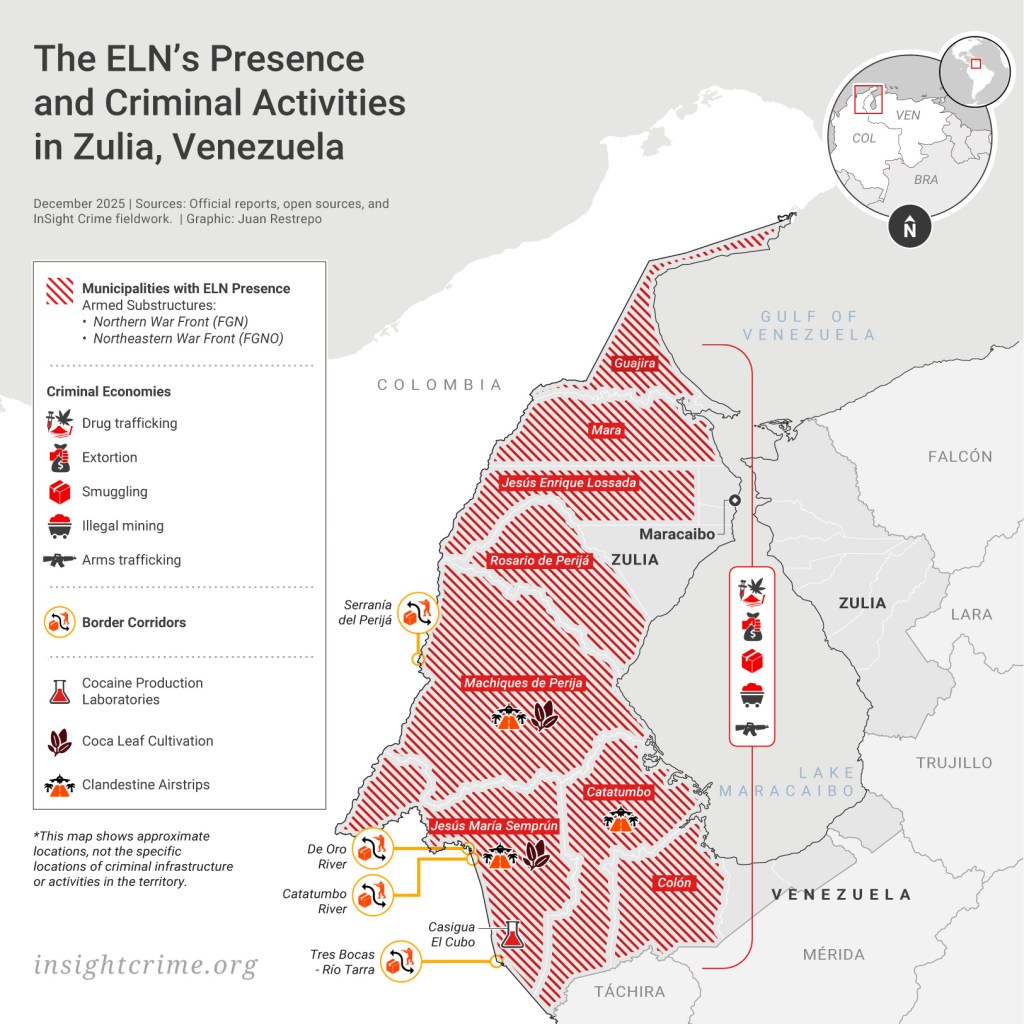
In Zulia it was particularly successful, and the ELN now has access through this Venezuelan state up to the Caribbean Coast. The ELN has not just relied on the benevolence of the Maduro regime to put down roots in Venezuela but replicated a strategy refined in Colombia over six decades. And the main motor behind this expansion has been an increasing ELN participation in the cocaine trade.