



“China supports the two sides continuing to enhance trust and clear doubts, and to take new steps on the road to de-escalation according to the communique,” Qin said.
Iranian Foreign Minister Amir-Abdollahian hailed the meeting as the start of official diplomatic relations and cooperation following a “common agenda”.
Iran’s state news agency IRNA reported that the prince had invited his Iranian counterpart to visit Saudi Arabia and the two officials had agreed to work to resume flights between the two countries and allow Iranian citizens to apply for a pilgrimage visa to visit Mecca.
Advertisement
The report also said the two countries had agreed to work to activate a general agreement to cooperate on the economy, trade, investment, technology, science, culture, sports and youth signed back in 1998, as well as a security cooperation deal signed in 2001.
Neither agreement has been implemented as a result of the increased tensions between the rival powers over the past two decades, reflecting the wider sectarian conflicts across the Middle East.

03:11
China, Iran pledge to deepen cooperation as both grapple with strained US ties
According to Asharq Al-Awsat, a London-based newspaper owned by the Saudi Prince Faisal bin Salman bin Abdulaziz al-Saud, the two officials pledged to continue following the road map set out in March.
The newspaper also cited a source in Riyadh saying the choice of Beijing for the meeting was an extension of its role in mediating the agreement and facilitating communication between the two countries.
Advertisement
China’s role in helping to restore relations between the two countries highlights its rising global influence and enhanced presence in the Middle East, despite the ongoing rivalry between the Saudis and Iranians both have become increasingly close to Beijing.
In the run-up to the agreement, Chinese President Xi Jinping visited Saudi Arabia in December, where he also took part in summits with the Arab League and Gulf Cooperation Council.
Advertisement
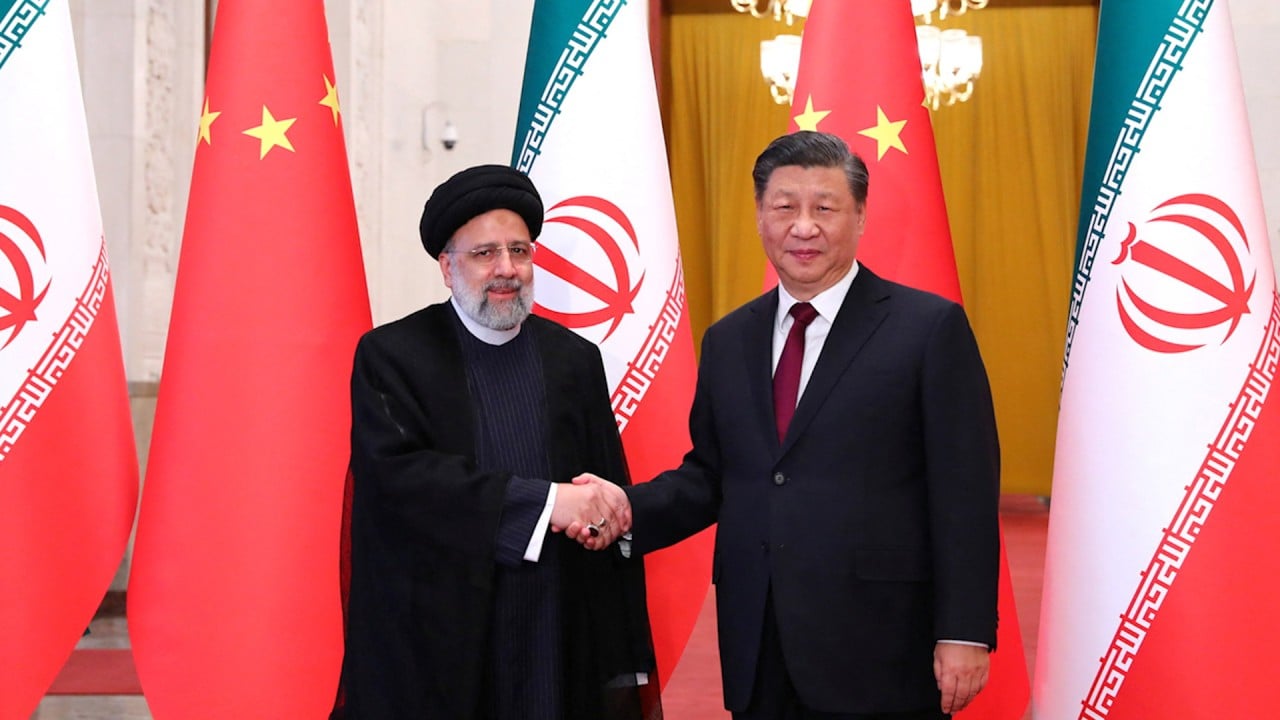
In February Xi also met Iranian President Ebrahim Raisi when he visited China.
The three parties jointly signed a communique on March 10 committing Iran and Saudi Arabia to reopening the embassies within two months while resuming talks on security, trade, investment and culture.
Since the signing of the communique, Xi has spoken by phone to Saudi Crown Prince Mohammed bin Salman, the kingdom’s de facto ruler in late March, and promised to help develop the kingdom’s relations with Iran.

02:16
China’s Xi Jinping visits Saudi Arabia in bid to boost ties amid strained US-Saudi relations
Chinese foreign ministry spokeswoman Mao Ning said that a joint statement issued after Thursday’s meeting had “expressed [both sides’] willingness to continue the process of improving their relations in accordance with the clear road map and timetable” set out in March.
Advertisement
“China is willing to continue to play an active role to support Saudi Arabia and Iran to continuously increase good neighbourliness, and promote security, stability and development in the Middle East,” she continued.
Wang Jin, a Middle East affairs professor at Northwest University in Xian, said it was “appropriate” that Beijing played host to the two foreign ministers because the meeting “is a continuation of the communique” issued in March.
“Other major powers in the international community are not suitable to assume this role, as Iran does not have diplomatic relations with the United States, while Russia is currently at war. Therefore, Beijing is still the only place for diplomatic restoration.”