


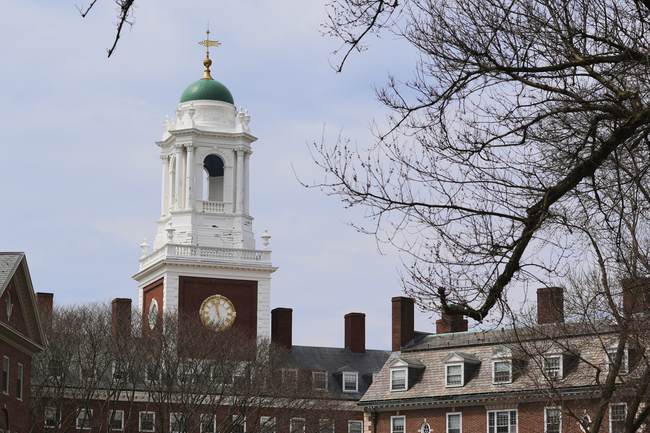
The Trump administration suffered a setback Thursday in its ongoing battle with Harvard University, when U.S. District Judge Richard Stearns granted Harvard’s motion to dismiss the government’s Title VI enforcement action, which accused the school of failing to protect Jewish and Israeli students.
Advertisement
Now, it’s key to note that Stearns did not find that Harvard hadn’t actually violated Title VI in the past. Instead, he held that the government failed to plausibly allege that Harvard remained out of compliance after the government formally notified the university of its alleged violations.
BREAKING: Federal judge dismisses DOJ’s Title VI lawsuit against Harvard. https://t.co/SR4JIgxkGN pic.twitter.com/BRAmc0HYli
— Chris “Law Dork” Geidner (@chrisgeidner) August 13, 2026
As readers may recall, the Department of Justice (DOJ) Civil Rights Division filed suit in March 2026, alleging that Harvard violated Title VI of the Civil Rights Act of 1964, which prohibits discrimination on the basis of race, color, or national origin in programs receiving federal financial assistance. But the DOJ’s amended complaint relies largely on incidents from the 2023-24 school year, plus three incidents from March 2025. Stearns describes those later incidents as “too isolated and episodic” to support an inference that institutional Title VI noncompliance has continued since.
Here’s the trick bag for the administration: Under Title VI, before the government can pursue enforcement, it must:
- advise the funding recipient of its failure to comply; and
- determine that compliance cannot be obtained voluntarily.
Advertisement
In this case, the Department of Health and Human Services Office of Civil Rights provided the relevant notice to Harvard on June 30, 2025. But the amended complaint alleges no subsequent events plausibly showing Harvard remained noncompliant after that notice. In other words, the government relied heavily on Harvard’s earlier conduct, but Congress structured Title VI enforcement around getting recipients into compliance after they’re notified, not simply punishing them for their prior sins.
The DOJ argued that even if there isn’t an ongoing violation, it should still be able to seek recovery of federal funds based on Harvard’s earlier violations. In his opinion, Stearns assumes (without deciding) that recovering previously awarded funds might theoretically be available under Title VI or a contract theory, but the DOJ still runs into the same statutory snag: its required notice came after the conduct underlying the claim, and there were no plausible allegations of subsequent noncompliance.
Can the federal government enforce federal antidiscrimination law against Harvard? No, because none of the examples of discrimination happened after Harvard was warned. Intriguing approach to Title VI discrimination–would seemingly render the whole statute toothless. pic.twitter.com/t4VH5D2r02
— Eric W. (@EWess92) August 13, 2026
Advertisement
The DOJ warned that Judge Stearns’ interpretation would make Title VI enforcement virtually impossible because a funding recipient could simply change course once the government threatens its funding. But Stearns’ rather pointed response to that is essentially, “Yes — that’s the point.”
To the extent the Government argues that this result makes it “virtually impossible for the United States to win a Title VI suit because a reasonable defendant would cease its indifference as soon as the United States threatens to withhold funding,” Opp’n [Dkt # 56] at 31 n.6, the Government misconstrues, inadvertently or not, the purpose of an enforcement action under § 2000d-1. Congress’s intent was not to penalize a wayward funding recipient but instead to incentivize it to bring itself into compliance with Title VI. Even in the Government’s fevered forewarning of potential havoc, it concedes that its own hypothetical result is a positive, if roughly achieved, outcome. If comfort is needed, the court’s ruling does not have as broad an impact as the Government asserts. This decision is limited to the specific circumstances presented here, where there is no plausible allegation of noncompliance following statutory notice.
Advertisement
Given that, Stearns granted Harvard’s motion to dismiss the case. To be clear, Stearns’ ruling does not exonerate Harvard over the 2023-24 conduct — in fact, he calls those earlier violations “less contestable.” Ultimately, though, his determination is that the government hasn’t alleged the post-notice, continuing noncompliance necessary to sustain this particular Title VI enforcement action.
If there’s a theoretical bright spot in this, it’s that the administration’s notice to Harvard seems to have had its intended effect.
No word yet on whether or not the administration plans to appeal this one. We’ll keep you posted.
Editor’s Note: Do you enjoy RedState’s conservative reporting that takes on the radical Left and woke media? Support our work so that we can continue to bring you the truth.
Join RedState VIP and use promo code FIGHT to receive 60% off your membership.