


Coca cultivation in Bolivia reached record levels for the third consecutive year, in an expansion that appears to be driven by global demand for cocaine rather than by the country’s legal coca leaf markets.
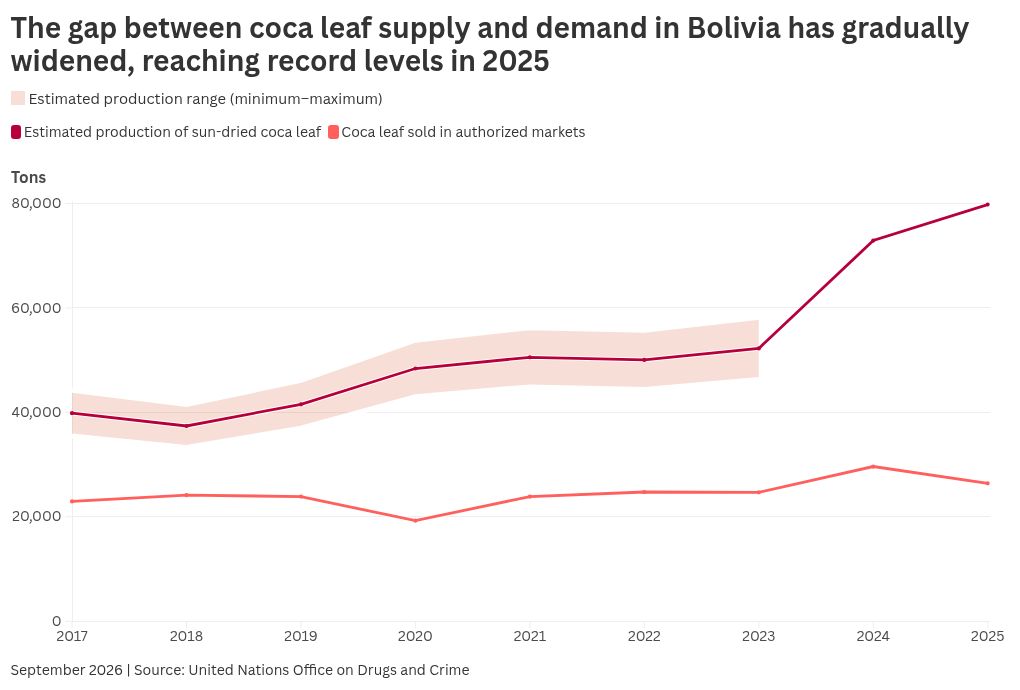
Bolivia has the world’s largest legal coca leaf industry. But while production has grown steadily, the legal trade has not kept pace, according to estimates published in the latest report by the United Nations Office on Drugs and Crime (UNODC), pointing to the likely diversion of coca leaf into cocaine production.
SEE ALSO: The Doubts Behind Bolivia’s ‘Biggest Cocaine Seizure Ever’
The country has steadily strengthened its role as a cocaine producer supplying global demand, while continuing to serve as a transit point for Peruvian cocaine, amid expanding international markets and record levels of consumption. Controlling this situation is one of the government’s main challenges. On September 16, the United States designated Bolivia as one of the countries that had “failed demonstrably” in its counternarcotics efforts.
The UNODC report states that coca cultivation now covers 36,400 hectares across the country, 65.5% more than permitted under the 2017 General Coca Law. The law sets the legal limit at 22,000 hectares, distributed between the Yungas region in the department of La Paz and, to a lesser extent, the Cochabamba Tropics.
As a result, the potential production of sun-dried coca leaf—the form in which it is preserved for traditional use—increased by 9%. After subtracting the coca leaf destined for the authorized market, potential cocaine production would have reached 275 metric tons.
Authorities have also identified more than 3,000 coca paste production sites and hundreds of cocaine hydrochloride crystallization laboratories in recent years. “The excess coca leaf produced goes directly to the laboratories,” Colonel Jorge Santistevan, Secretary of Citizen Security for the department of Santa Cruz, told InSight Crime.
From Expanding Coca Crops to Transnational Cocaine Trafficking
The expansion of coca cultivation in Bolivia is concentrated mainly in the provinces that make up the Cochabamba Tropics, a region where most coca production is diverted to illegal markets and where the state exercises limited control.
Although the region is legally authorized to cultivate 7,700 hectares of coca, the area under cultivation reached 17,470 hectares in 2025. Within the region, Chapare province accounts for most of the coca crops and for the largest number of coca paste production sites and cocaine crystallization laboratories destroyed by authorities in the country.
Although the region has an authorized market for coca leaf sales, less than 10% of its production was sold through that market in 2025.
The government’s ability to control the area is widely questioned. Historically, the region was a center of conflict between coca-growing peasant unions and the state because of forced eradication policies and the associated state repression, which continued into the early 2000s. Since then, the coca growers’ movement has maintained significant social and political influence and control in the region.
Authorities have been unable to arrest Evo Morales, a Chapare coca growers’ leader and former president of Bolivia, who is believed to remain in the region and has been a fugitive from justice since late 2024. Morales failed to appear for trial on allegations of human trafficking and the abuse of a minor, and was later accused of terrorism and insurrection against the state in connection with protests against the government in 2026. In addition, coca growers’ unions blocked eradication efforts in the area amid disputes with Morales’ successor and political rival, Luis Arce, helping to explain part of the growth in coca cultivation during this period.
A large share of coca production in the Cochabamba Tropics supplies transnational drug trafficking organizations, with Bolivian family clans acting as intermediaries. The violence linked to this activity offers a glimpse of that criminal presence. Between August and mid-September 2026, at least 16 killings linked to drug trafficking were recorded in the departments of Cochabamba, Santa Cruz, and Beni.
Former Vice Minister of the Interior and Police Jhonny Aguilera told InSight Crime that contract killings are concentrated along strategic drug trafficking corridors, including the border between Cochabamba and Santa Cruz departments, the area along Santa Cruz’s border with Brazil, and parts of Beni where clandestine airstrips are located.
“From a statistical standpoint, Bolivia does not stand out as an exceptional case. But it does stand out for local communities, which were not accustomed to this level of crime in the past,” he said.
The government of Rodrigo Paz, who won the 2025 elections, moved to restore relations with the US Drug Enforcement Administration (DEA) after 18 years without cooperation. Despite some progress, including the arrest of drug trafficker Sebastián Marset in the city of Santa Cruz, the US administration has maintained Bolivia’s designation as a country that has failed demonstrably in its counternarcotics efforts. According to the official statement, the United States left the door open to reversing the designation in the future if Bolivia reduces coca cultivation and pursues corruption.
For its part, the Paz government introduced a new counternarcotics policy for 2026-2030, with a strong focus on institutional strengthening and international cooperation. Bolivia also works with international partners, including Brazil, Chile, and the European Union, as well as receiving assistance from the United Nations. Among the new policy’s nine strategic pillars is the responsible control of coca leaf cultivation.