


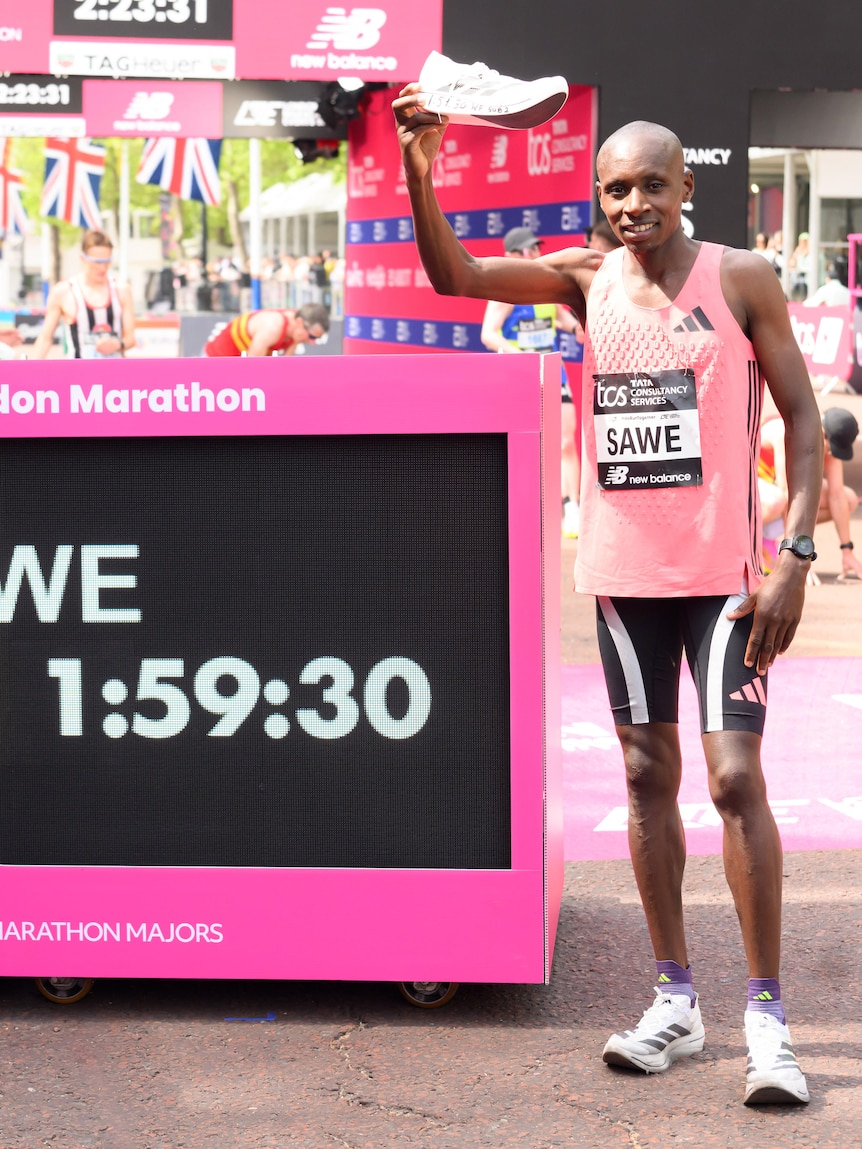
When Sabastian Sawe broke the tape on The Mall on Sunday, having run the London Marathon in a stunning 1 hour 59 minutes and 30 seconds, Steve Cram was speaking for so many gob-smacked running fans.
“That, you would say, is unbelievable, but we have just seen it,” the former track world champion said on the BBC.
“Nobody has ever done this. They said it couldn’t be done.”
Any time the word “unbelievable” is used in a sporting context, an alarm bell normally starts ringing.
Even those who resolutely channel the X-Files’ Agent Fox Mulder in their desperation to believe in the impossible sometimes need some level-headed Sherlock Holmesian pessimism as the only rational discourse — accepting the most likely explanation as the real truth.
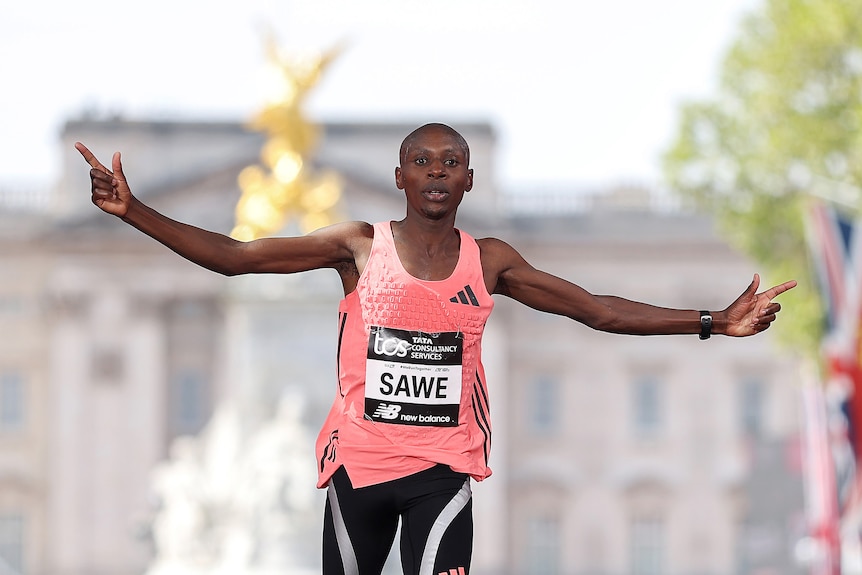
Kenyan distance running has a new king in Sabastian Sawe. (Getty Images: Alex Davidson)
Athletics is not alone in being plagued by doping scandals, with performances being questioned time and time again in recent years across a multitude of sports, but it has had a particularly bad run of late.
Women’s world record holder, Ruth Chepngetich, is serving a three-year ban for testing positive for the banned diuretic hydrochlorothiazide.
Chepngetich predictably denied any wrongdoing, somewhat inexplicably saying she had taken some of her housemaid’s medication after feeling hot and having a rapid resting heartbeat.
Athletics Integrity Unit investigators, having studied her text messages and determined that the doping was likely intentional, found her baffling claims to be “hardly credible”.
The Kenyan had stunned the world when she ran the Chicago Marathon in 2 hours, 9 minutes, and 56 seconds, almost 2 minutes faster than the previous world record, prompting many to call it “unbelievable”.

Ruth Chepngetich has been disgraced after testing positive for a banned diuretic. (Getty Images: Chicago Tribune/Tribune News Service/Tess Crowley)
That record still stands — albeit with a suitably-sized asterisk next to it — because the positive test came some time after the run.
In fact, it was days before she was due to run in the 2025 London Marathon that Chepngetich’s cheating was exposed when she was a late withdrawal.
That’s not the only bombshell cheating claim to come to light in recent months.
Paris Olympian Jackline Sakilu was banned for a massive 10 years after evidence the Tanzanian athlete had microdosed androsterone and etiocholanolone over long periods of time, including during the Paris Games.
Meanwhile, former men’s world record holder Wilson Kipsang was banned for four years in 2020 due to missed doping tests and tampering with an investigation.
So, when anyone describes a performance as “unbelievable”, it’s perhaps worth having a closer look.
Fortunately for those who hope to believe what they saw on the streets of London on Sunday, Sawe is one of those who has been asking for a closer look too.
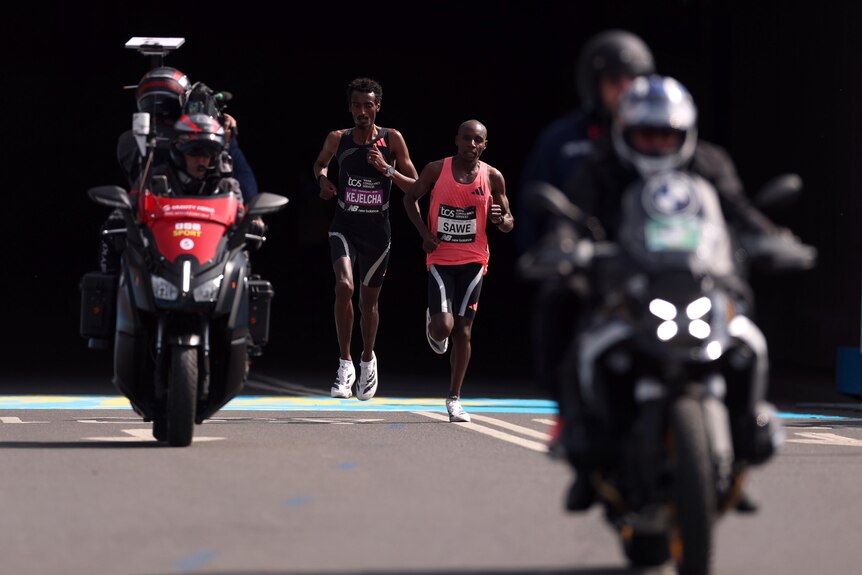
Both Sabastian Sawe and Yomif Kejelcha beat the two-hour mark. (Getty Images: Warren Little)
Sawe has spoken out in the past about problems with doping in the sport of marathon running.
And, rather than just cast out phrases of disappointment, he has acted on it, too.
Given Kenya’s woeful recent record on doping, the 30-year-old took the extraordinary step of calling for himself to be tested more regularly, inviting the Athletics Integrity Unit (AIU) to test him as often as possible.
Last year, it did so, 25 times in fact, in the two months leading up to his attempt at the record in the 2025 Berlin Marathon — an attempt he was on track for before the hot conditions caused him to drop back in pace and settle for the win.
This is reportedly funded by his principle sponsor, adidas, to the tune of tens of thousands of dollars — $50,000 according to his coach, Claudio Berardelli.
“The main reason was to show that I am clean, and I am doing it the right way,” Sawe said at the time.
Italian coach Berardelli has had anti doping issues himself in the past, being linked to several camps in Ethiopia where doping was found to be taking place.
Now, he appears to be going to great lengths to ensure his athletes are clean, telling journalists after the race that although the testing had reduced in frequency since the Berlin build-up, Sawe was still under “special anti-doping protocol”.
“Yesterday I was with the AIU and they said he had been tested more [than other athletes],” he said.
“Of course, what happened was the budget we had before Berlin, the AIU decided to spread it throughout the year because they said it didn’t make sense to have him tested every three days, it’s too much.
“Still, Sabastian is in a special anti-doping protocol.”
The record will be subject to the usual ratification procedures before it is confirmed by World Athletics, and given the unpleasant track record of athletes, there’s no telling if this astonishing run was completely legitimate.
But British Olympic champion Mo Farah seems convinced.
“We’ve waited long enough to see a human go sub-two,” he said, perhaps alluding to the robot runners of China that recently broke the human half marathon world record.
“That’s always been the question that we’ve asked. We’ve just witnessed something incredible.”
How fast did Sawe run?
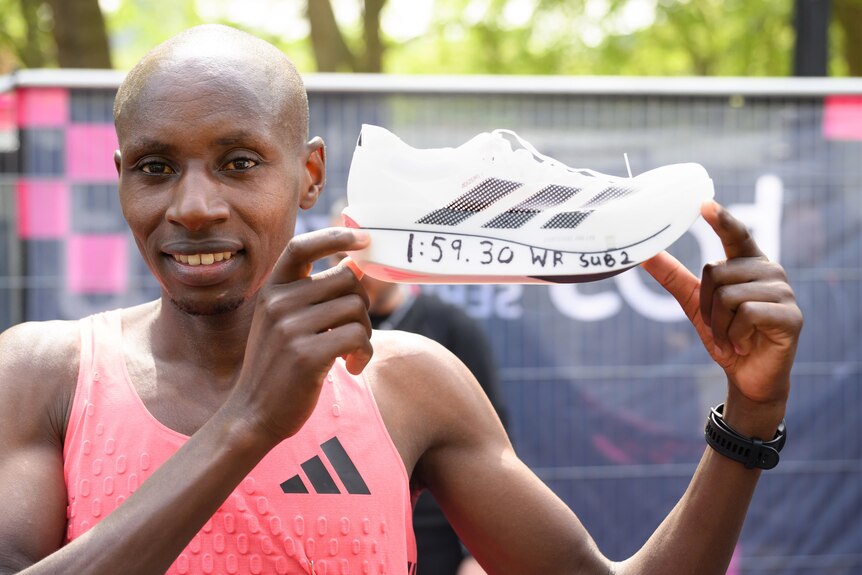
Sabastian Sawe with the now-traditional Monty Python-esque holding up of the shoe. (Getty Images: Karwai Tang)
A milestone-shattering record of this magnitude needs to be put into its appropriate context.
First up, some history.
The two-hour mark has been seen as the holy grail of marathon running, the limit of human capability in much the same way that the four-minute mile was in the immediate post-World War II era.
It was such a pivotal mark that INEOS was reported to have spent upwards of $20 million on its INEOS 1:59 Challenge in 2019.
There, double Olympic champion Eliud Kipchoge did beat the two-hour mark in a run conducted under extreme time-trial conditions, with a laser-guided tracker and rotating pace makers, meaning World Athletics was never going to ratify the time.
But this was in a genuine race — arguably the biggest of them all — the London Marathon.
The time Sawe ran was more than a minute faster than the late Kelvin Kiptum‘s previous record of 2:00:35, set in 2023.
Incidentally, Kiptum also held the London Marathon course record of 2:01:25.
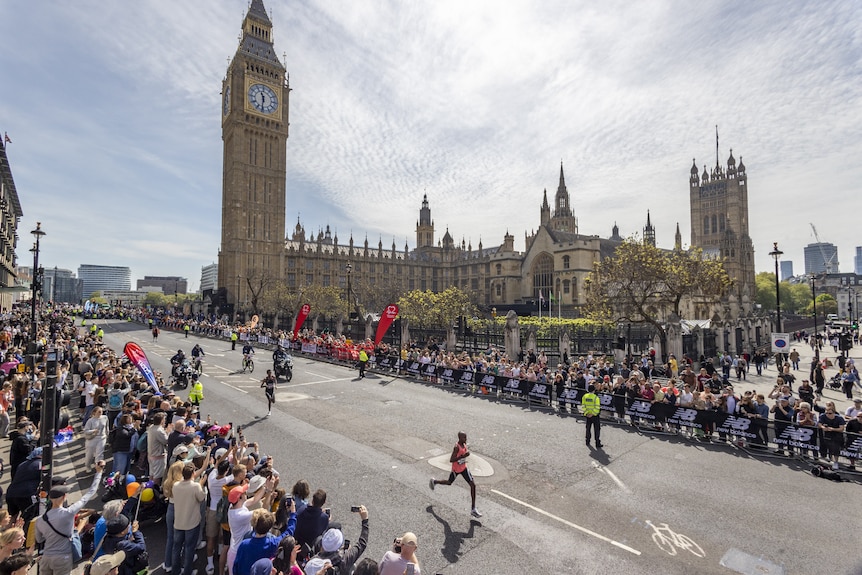
Sabastian Sawe declared himself sporting royalty on the streets of London. (Getty Images: Anadolu/Marcin Nowak)
Earlier in the week, Sawe had told the BBC he was keen to go fast and that it was “only a matter of time” before he broke Kiptum’s world record.
He added, “I hope and wish one day [it will be me]” to be the one to break the two-hour barrier.
He wasn’t the only person to do so on Sunday, but the man who finished behind him, marathon debutant Yomif Kejelcha, also broke the near-mythical record, finishing runner-up in 1:59:41, both men pushing each other to greater heights.
That says it all about how good the conditions were — light winds and temperatures in the mid-teens are ideal for marathon running.
Earlier in the day, Tigst Assefa of Ethiopia broke her own women’s-only world record en route to victory, crossing the finish line in 2:15.41, beating the record of 2:15.50 she set last year in London.
This is slower than Chepngetich’s all-time record because faster elite men can act as pacemakers for women when the races start at the same time.
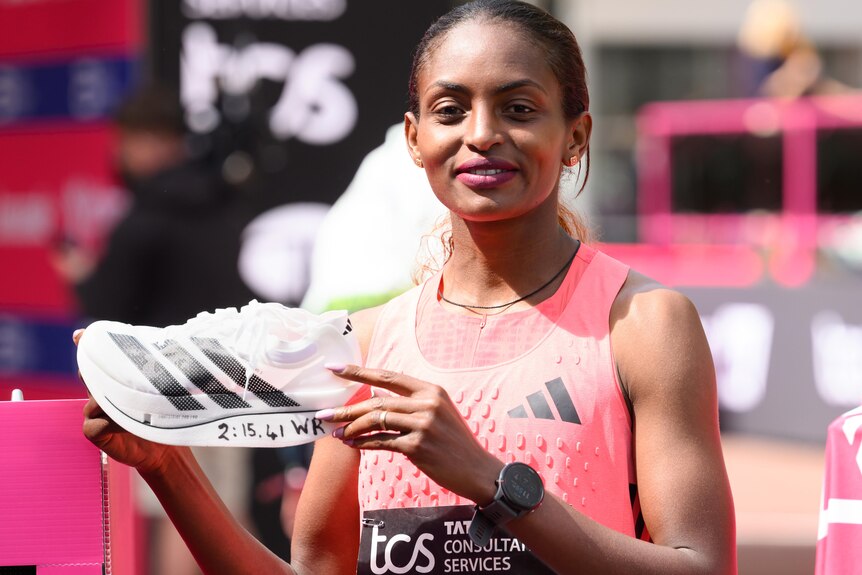
Tigst Assefa celebrated her own world record with some shoe doodling too. (Getty Images: WireImage/Karwai Tang)
London’s flat and fast course has just 75m of elevation gain over 42.2km, similar to Berlin (73m) and Chicago (74m), perennial record-chasing hot spots among marathon majors. Add a generational talent and the latest of adidas’ super shoes, and you have a recipe for sub-two-hour success.
But even so, this was remarkable.
“There are things that happen in sport, and you want to be there to see history being made,” Cram said.
“Roger Bannister [running] the first ever four-minute mile — those who were there on that day still tell that story today.
“We said it was a day for records, but I don’t think in our wildest dreams we could have foreseen this.”
What does that mean for your average punter?
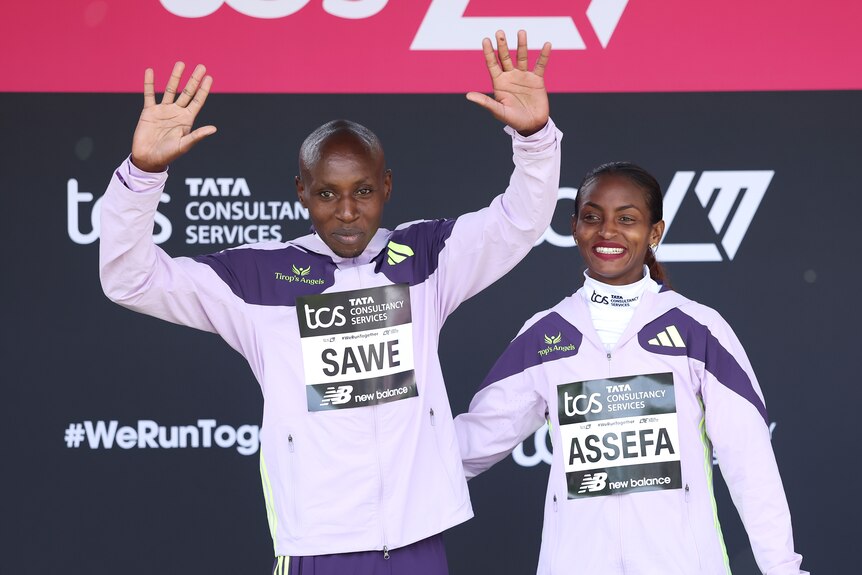
Sabastian Sawe and Tigst Assefa broke the men’s and women’s world record. (Getty Images: Alex Davidson)
Watching a marathon on TV can be desperately misleading — men and women running alongside each other give barely any reference point to show how fast they are actually going.
Standing on course, catching a glimpse of these wisp-like runners blur through a gap between the crowds shows what TV cannot — an insane level of continuous speed that’s hard to immediately fathom.
Imagine going down to your local parkrun — which is 5km — and reeling off a time of 14 minutes and 10 seconds. For the record, the average time for an Aussie to complete a parkrun is 33:31.
That’s what time Sawe averaged for each 5km of his marathon. However, he did that pace for eight parkruns in a row without a break, then ran another half-distance parkrun for good measure.
Incredibly, he actually ran the second half of his run faster than his first, a phenomenon known as negative splitting.
He went through the first 21 kilometres in 60:29 but put the hammer down for the second half marathon to record a time of just 59:01 — incidentally, only 63 men in history have run a half marathon on its own as quickly as that.
His last 5km block before the finale, from 35km to 40km, was run in 13:42.
Again, for comparison’s sake, the fastest ever 5km parkrun stands at 13:44, set by Irish teenager Nick Griggs at the Belfast Victoria parkrun on November 9. The fastest in Australia is James Hansen’s 13:53.
“This will reverberate around the world,” Paula Radcliffe, a former record holder for the women’s marathon, told BBC Sport.
“The goalposts have literally just moved for marathon running and where you benchmark yourself as being world class.
“It is a lesson to everybody out there. We say, ‘Don’t go out too fast’ — they went out smartly and paced it really well.”
dan