


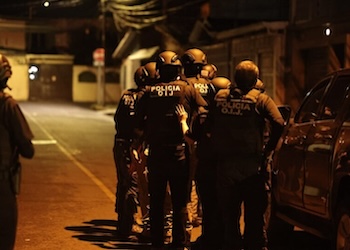
Authorities in Costa Rica are on high alert after uncovering the so-called South Caribbean Cartel, reportedly the country’s first transnational criminal organization, which may have severe implications for security policy in the Central American nation amid escalating violence and corruption scandals.
Local officials declared the South Caribbean Cartel as the country’s first transnational criminal organization following a November 4 operation that led to the arrest of nearly 30 people and the seizure of almost 14 tons of drugs, mostly cocaine, as well as 68 high-powered weapons, seven luxury condominiums, 40 properties, and 73 vehicles and boats.
The group allegedly counted on high-ranking government officials to operate, as well as a network of associates working in Costa Rica and across Latin America, the United States, and Europe, according to local media reports.
The Emergence of the South Caribbean Cartel
Led by brothers Luis Manuel, alias “Shock,” and Kevin Picado Grijalba, alias “Noni” – both imprisoned and wanted by the United States for drug trafficking – authorities say the South Caribbean Cartel is the main distributor of marijuana and cocaine in Costa Rica.
In just four years, the criminal group evolved from a local gang to a transnational organization. During this time, authorities said its members took advantage of the murder of key intermediaries like Leonardo Antonio Joseph Méndez, alias “Chombo,” and forged alliances with influential figures in Costa Rican drug trafficking, such as Edwin Danney López Vega, alias “Pecho de Rata,” and Gilbert Bell Fernández, alias “Macho Coca,” both of whom have been sanctioned by the US Treasury Department and accused of being major cocaine traffickers.
SEE ALSO: Panama, Costa Rica: Major Waypoints For Cocaine to Europe
These connections, some of whom had high-level political and business ties, expanded their access to trafficking routes and contacts. This was evidenced by group members’ constant travels to Panama, Colombia, Nicaragua, the United States, France, and Mexico.
From Local Gang to Transnational Criminal Organization
The South Caribbean Cartel allegedly maintained direct contact with Colombian cocaine suppliers operating in the departments of Nariño and Cauca, with resupply points located off the coast of Panama.
Once the drugs reached Costa Rica, the group unloaded the shipments on remote beaches such as Osa, Puerto Jiménez, and Golfito, according to a review of the case file by local media. From there, the drugs were transported to warehouses in Puntarenas and the Central Valley for distribution throughout the rest of the country. The group also handled moving shipments to Nicaragua, largely due to contacts it established in Colombia and Central America. Authorities also said the group trafficked drugs by air using countries like the Dominican Republic, Jamaica, Mexico, and the United States.
In addition, Costa Rica’s Judicial Investigation Agency (Organismo de Investigación Judicial – OIJ) reported that the South Caribbean Cartel relied on a network of hitmen to consolidate its territorial control. This enforcement wing was allegedly commanded by Tony Alexander Peña Russell, alias “La T,” who was sentenced last August for 78 murders.
It is unclear whether this group is still active after the latest operation. The US Embassy in Costa Rica said that authorities dismantled the network, but local authorities continue to reference it in the present tense.
A Criminal Rise With Security Implications
The designation of the South Caribbean Cartel as a transnational criminal group has stirred debate among local authorities. Attorney General Mauricio Boraschi has urged caution in presenting the group as Costa Rica’s first transnational criminal organization. However, former Security Minister Michael Soto Rojas emphasized the group’s transnational reach, as well as its use of extreme violence, money laundering capabilities, and territorial control in the South Caribbean, the Pacific, and the Gulf of Nicoya, primarily on Chira Island.
Declaring the South Caribbean Cartel as Costa Rica’s first transnational criminal organization comes amid growing security concerns in the country. While several political and business elites have been ensnared in corruption scandals, authorities have also noted increased violence – mainly homicides – as well as the rise of local criminal groups.
SEE ALSO: Costa Rica Is Facing Its Worst-Ever Narco Corruption Scandal
Costa Rica has also emerged as much more than just a transshipment point in the international cocaine trade, becoming a “warehouse and logistical operations zone,” said Karen Morales, professor and director of the police science program at the National University of Distance Education (Universidad Nacional de Educación a Distancia – UNED).
Morales added that the South Caribbean Cartel could signal the beginning of a further criminal evolution in the country.
“This is the first criminal structure identified as a cartel in Costa Rica, and it probably won’t be the last,” she told InSight Crime.
As a result, this may push officials to change security policies. Thus far, deploying specialized police officers and increasing drug trafficking prosecutions have proven insufficient.
Featured image: Costa Rican authorities prepare their operation targeting the South Caribbean Cartel. Credit: Diario Extra