


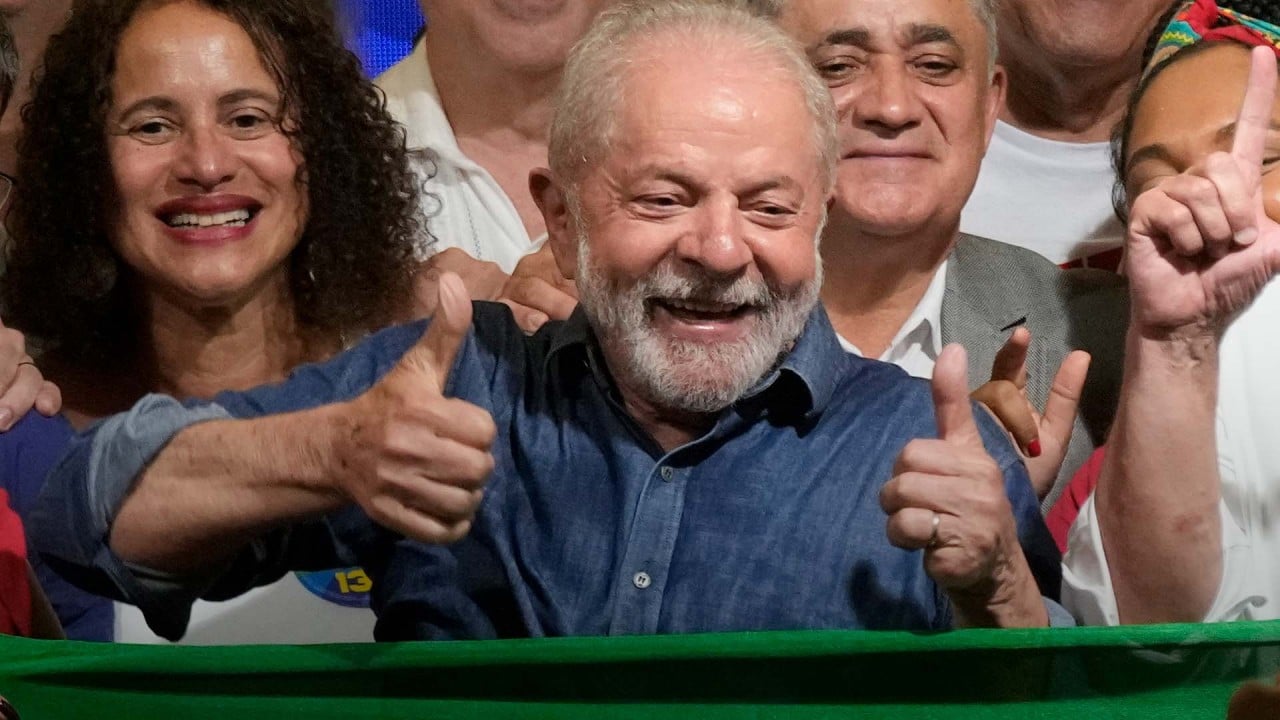
After arriving on Wednesday, Lula’s first stop was the New Development Bank on Thursday to witness the inauguration of former Brazilian president Dilma Rousseff as the president of the Shanghai-headquartered bank.
The bank was jointly set up in 2014 by five BRICS countries – Brazil, China, Russia, India and South Africa.
Advertisement
Lula spoke with executives about the bank’s ongoing and potential projects in Brazil – in areas such as renewable and clean energy; modern transport infrastructure and urban mobility; and water and sanitation efficiency – according to the bank’s online statement.
In his speech, he called on the BRICS bloc to settle bilateral trade and investments in their own currencies.
“I’m thinking about the same question every night: why should all the countries use US dollars for settlements and not the yuan or other international currencies,” he was quoted as saying by Chinese media group The Paper, citing a translation of his speech made in Portuguese.
“Why can’t the New Development Bank extend loans in the currencies of member countries? I know we are accustomed to using the US dollar, but we are in the 21st century, and we can do something different.”
Visitei o centro de desenvolvimento de tecnologias da Huawei. A empresa fez uma apresentação sobre 5G e soluções em telemedicina, educação e conectividade. Um investimento muito forte em pesquisa e inovação.
📸: @ricardostuckert pic.twitter.com/d3AHmcda1U
— Lula (@LulaOficial) April 13, 2023
Brazil is China’s tenth-largest trading partner, with bilateral trade value rising by 4.9 per cent to US$171.5 billion last year, according to Chinese customs data.
Advertisement
The South American country is a major import source of iron ore, beef and agricultural products. First-quarter bilateral trade rose 5.5 per cent from a year earlier to US$36.4 billion.
The 78-year-old Brazilian president also visited a Huawei Technologies research centre in Shanghai.
Advertisement
Huawei, which established its Brazilian operations 25 years ago, began offering cloud services there in 2019 and became the country’s third-largest service provider last year, according to Brazilian media group Teletime, citing data from market research firm Gartner.
Despite accounting for only 5 per cent of Huawei’s total revenue in 2022, the Americas are jointly considered one of the company’s fastest-growing markets.
02:06
China-Brazil relations likely to strengthen with newly elected leader Lula, analysts say
Huawei’s tech has also become an integral part of Brazil’s 5G deployment. TIM and Vivo, two of the three 5G telecom operators in Brazil, have been working with Huawei since 2019 and 2020, respectively, to test 5G networks in the country.
Advertisement
Despite moves by the US to “pressure the Brazilian government to prevent Huawei from inclusion in the construction of the country’s 5G networks”, the top Chinese telecoms equipment maker has become a “trusted partner to the government” and has helped its public institutions go digital, Huawei said on its official website.
“Working with Brazil’s telecoms operators, Huawei has connected more than two-thirds of the country’s population in more than 20 cities,” it added.
On Friday, President Xi Jinping is expected to meet Lula, who travelled to China with a large delegation of ministers, state governors and business leaders, in Beijing.
Advertisement
Lula’s official website listed the ministers of finance, environment and climate change, agriculture and livestock, science, technology and innovation, foreign affairs, social development, as well as mines and energy, as part of his delegation in China.