


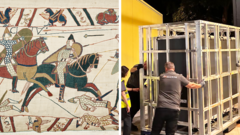
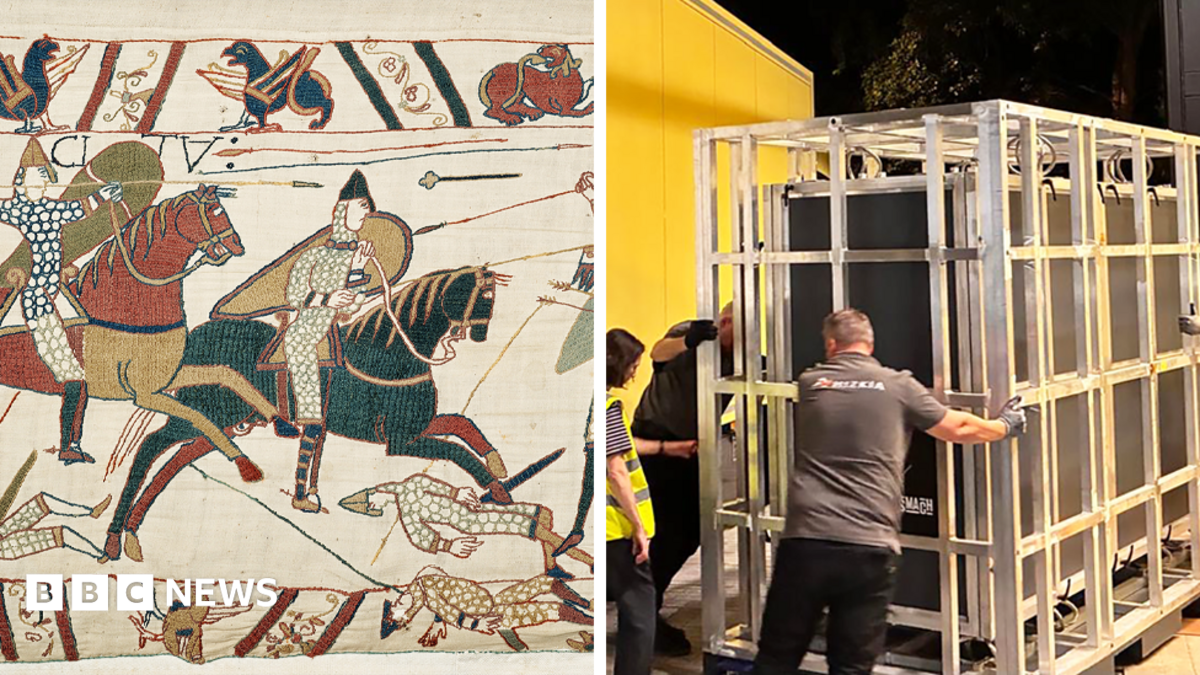
The Bayeux Tapestry is not actually a tapestry at all: it is linen with embroidered pictures of the tussle between William, Duke of Normandy then Conqueror of England, and Harold II, King of England, stitched on in coloured woollen yarn.
An embroidery of immense significance – 58 scenes, 626 characters (but only six women), 202 horses – ships, swords and arrows (including one hitting the soldier believed to be Harold II – although there are questions about whether this was added later).
Horton-Insch said it was a “miracle” that the artwork had survived for more than 900 years. “Moths, mice, damp, mould, fire any number of things” could have wrecked it.
“It is just an extraordinary survival.
“It tells the story of one of the most consequential moments in English history, British history, in the most incredibly vivid way that just can’t be captured in written sources.”
The Bayeux Tapestry is an epic depiction of the end of Anglo-Saxon England.
The Norman Conquest changed everything, reshaping the country entirely. English lands were handed over to the Norman nobles. The Normans built hundreds of castles which secured their control and projected royal power.
English earls were replaced with Normans, as were senior members of the Church.
And thousands of French words that we still use today entered the English language – everything from law, parliament and justice to mutton, beef and pork.
The tapestry gives an account of the medieval period in Normandy and England like no other. It provides information about civil and military architecture, armour and seafaring in the Viking tradition, as well as precious details of everyday life.
Before 1066, the nation’s cultural and political ties were to Scandinavia and the North Sea. After the Norman conquest, it became part of a Norman realm stretching across the English Channel. It is sometimes said to be the start of England’s involvement in continental European politics.