


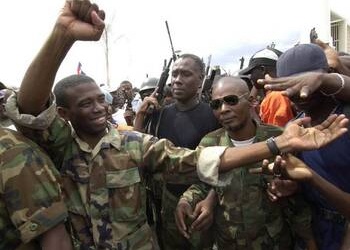
The return of a former Haitian senator found guilty of money laundering in the United States could trigger further unrest in a country already rocked by gang violence and political instability.
The US government repatriated Guy Philippe, a former police officer, senator, and coup plotter, to Haiti on November 30. Before Philippe’s return to the island, he served six years in a US prison after pleading guilty to charges of conspiracy to launder money from drug trafficking between the late 1990s and the early 2000s.
SEE ALSO: Haiti Crime Boss’ Death Signals Possible Shift in Balance of Power
Upon his return to Haiti, the Central Directorate of the Judicial Police (Direction Centrale de la Police Judiciaire – DCPJ) arrested Philippe, who had a pending court order in relation to a 2016 attack on a police station. The authorities released him on December 2, following three days of interrogation.
Philippe’s political relevance stems from his participation in the 2004 coup against then-President Jean-Bertrand Aristide. The coup and international pressure from the US pushed Aristide to flee the country.
Philippe was elected senator in 2016, despite the US linking him to drug trafficking during the campaign. But he never took office, as the police arrested him almost immediately after his election to extradite him to the US.
InSight Crime Analysis
It remains to be seen exactly what effect Philippe’s return will have on Haiti’s criminal dynamics. But some expert hypotheses suggest that he could try to combat gang violence either through institutions or by acting outside the law.
On one hand, Philippe could take advantage of his political, economic, and police connections to insert himself in the presidential race and mitigate the impact of gang violence through institutional measures.
However, in this hypothetical situation, Philippe would have to be “perceived by the population as someone who can bridge the gap between the gangs, the government, and the opposition,” explained Robert Fatton, an expert in Haitian politics and professor at the University of Virginia.
SEE ALSO: Haiti Senator-Elect Pleads guilty to Money Laundering in US
In this scenario, connections with gang leaders would also help Philippe cement his role as a mediator, a possibility that is not unrealistic. Fatton told InSight Crime that, given Philippe’s previous role as a police officer, he likely has connections to Jimmy Chérizier, alias “Barbecue,” who is also a former police officer and current leader of the G9 and Family gang alliance.
The second possibility is that Philippe could lead a self-defense movement to keep gangs out of the department of Grand’Anse, in the southwest of the country, Patrick Pelissier, director of the Human Rights Institute in Haiti, told InSight Crime. During his senate campaign, Philippe garnered significant support in this department, which could easily translate to popular support for a self-defense movement.
Although Haiti’s traditional gangs were created in the capital of Port-au-Prince, they have been expanding into rural areas since 2015. Their consolidation in these areas has been helped by alliances between some gangs, and they have brought kidnappings, sexual violence, and assassinations along with them.
In the face of this deteriorating security, some high-ranking security officials, such as Jean Ernest Muscadin, have led so-called self-defense movements to protect rural areas, especially in the southeastern part of the country. If Philippe took the self-defense movement route, Pelissier said, “this area would be almost completely protected, since we would have Muscadin and Philippe keeping the gangs on the sidelines.”
Related Content
What are your thoughts?
Click here to send InSight Crime your comments.
We encourage readers to copy and distribute our work for non-commercial purposes, with attribution to InSight Crime in the byline and links to the original at both the top and bottom of the article. Check the Creative Commons website for more details of how to share our work, and please send us an email if you use an article.