


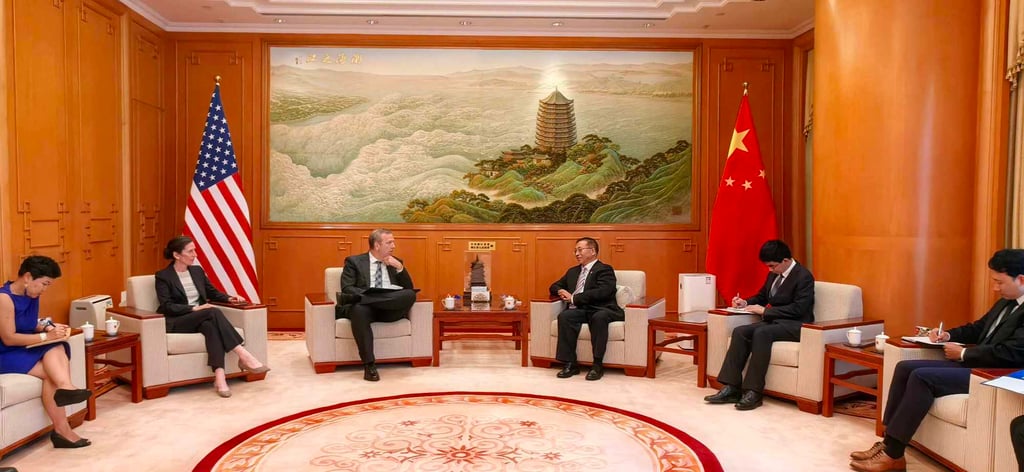
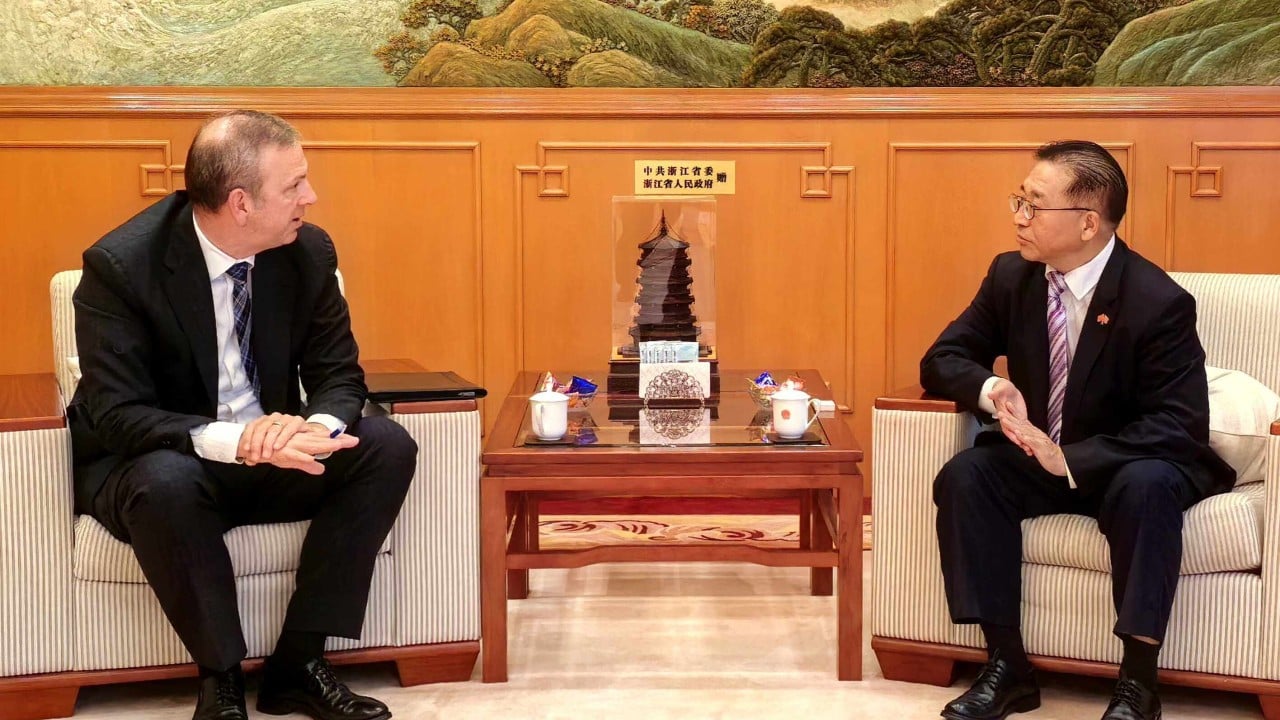
Beijing’s top diplomat in Hong Kong met the leading US envoy in the city on Wednesday and hit back at the country’s “recent negative remarks”, after the American official said the “one country, two systems” governing principle only existed on the economic front.
It was the second time in about a week that Cui Jianchun, the commissioner of the Chinese foreign ministry’s office in Hong Kong, had hit out at remarks from Gregory May, the United States’ consul general for the city and Macau.
The commissioner’s office issued a statement on Wednesday evening that revealed the meeting had taken place.
“The commissioner … has expressed his solemn position on the recent negative remarks and deeds of the United States over Hong Kong, and urged the US to implement the important consensus reached by the heads of China and the US at the San Francisco meeting together,” the office wrote.
Last November, Chinese President Xi Jinping and US leader Joe Biden agreed during high-level talks to strengthen dialogue and cooperation in various fields, such as narcotics control and artificial intelligence, resuming communication between militaries, and boosting exchanges in fields such as culture, education and business.
The office said on Wednesday that Cui had introduced the spirits of the third plenary session of the Communist Party’s 20th Central Committee to May during the meeting, with both sides also exchanging views on how to foster dialogue, exchanges and practical cooperation in relevant fields between Hong Kong and the US.
In response to the meeting, a spokeswoman for the US consulate in Hong Kong said: “It was a productive conversation about topics of mutual interest.”
Cui earlier issued a statement urging May to stop “spending time fabricating lies, attacking and badmouthing the city” after the US envoy told CBS News that Hong Kong had “fundamentally changed” in recent years, with people’s rights and freedoms being taken away.
May argued the guiding principle of one country, two systems only existed in Hong Kong’s economic realm, but not in “the broader political and way-of-life realm”.
His remarks also drew a fierce response from the Hong Kong government, which slammed the US top diplomat for making “absurd and unfounded remarks”.
According to the website for the commissioner’s office, Cui last met the US envoy in May, when they exchanged views on implementing the consensus reached by the two countries in San Francisco.
Last year, Cui’s predecessor, Liu Guangyuan, met May and laid down three red lines for him that included a warning not to endanger national security.
The warning prompted the US consulate to issue a defiant statement that said it would continue to express its concerns over the “erosion” of Hong Kong’s high degree of autonomy.
The meeting in February of last year took place after May told a seminar by Washington-based think tank the Centre for Strategic and International Studies that Beijing’s interpretation of the national security law “could further undermine the independence of Hong Kong’s judiciary system”.
May at the time was referring to the ruling by Beijing’s top legislative body that Hong Kong’s leader and the city’s Committee for Safeguarding National Security should decide whether overseas lawyers were permitted to take part in sensitive legal cases.
The US diplomat also accused the Hong Kong government of curtailing press freedoms since the enactment of the national security law imposed in response to the 2019 anti-government protests.