


There was a familiar element when police in Guyana’s capital of Georgetown raided the Red Dragon nightclub in the early hours of August 24, 2024. During the operation, officials said they rescued 26 women, among them Venezuelans, Cubans, and Dominicans, from “exploitation and other forms of abuse.”

*This article is part of a three-part investigation, “Is Venezuela Using Criminals to Provoke Guyana?” InSight Crime spent a year analyzing how organized crime has penetrated Essequibo, the dense Amazon jungle region in Guyana claimed by Venezuela. Read the other chapters in the investigation here.
Less than six months prior, police discovered 44 foreign women at the same club who had allegedly been trafficked, exploited, and abused.
The Venezuelan victims, like many vulnerable people trafficked in Guyana, likely passed through Essequibo, the large region along Guyana’s border with Venezuela that is at the center of an escalating territorial dispute between the two nations and under review by the International Court of Justice.
Thousands of Venezuelans migrants have moved into Guyana to escape economic turmoil and political repression that has increased since President Nicolás Maduro’s inauguration in January, following an election win in July 2024 that was widely decried as fraudulent. Meanwhile, an influx of oil money has boosted Guyana’s economic fortunes, making it an evermore attractive destination for desperate migrants seeking a better life.
But as Guyana grows as a destination for migrants from Venezuela and elsewhere, its appeal has also increased for human traffickers. And while Venezuelan trafficking victims generally pass through Essequibo before arriving in the capital, not all victims make it that far. In August 2023, two Venezuelans were among four women rescued after having been forced into sex work in a mining area in Region 7.
Ultimately, the growing migration of Venezuelans into and through the Essequibo region aligns with Maduro’s strategic interest in asserting control over the area, as it could facilitate both demographic and territorial consolidation to strengthen his regime’s claims. And the Guyanese government remains poorly positioned to confront the issue.
Mining Creates Labor Demand
Venezuelan human trafficking victims arrive along the same routes used to smuggle other migrants into Guyana, such as the Cuyuní River, from San Martín de Turumbán in Venezuela to Eteringbang and then onward. Others reach Guyana by crossing the maritime border via the Orinoco River into the Atlantic and leading to Mabaruma in Region 1.
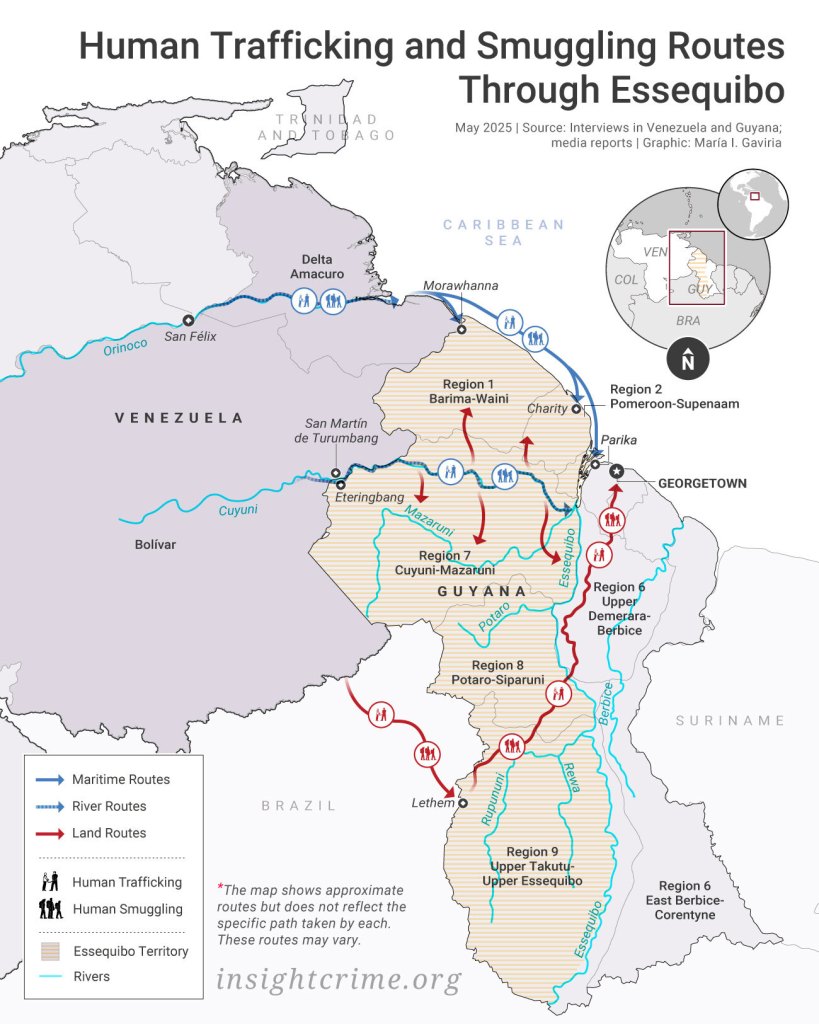
Some victims are brought to Georgetown, with traffickers severely limiting their freedom of movement, former Public Security Minister Khemraj Ramjattan told InSight Crime.
“They are under the supervision of some very big terrorist kind of operators who do all manner of things to them. And they take them to big businessmen in Guyana,” he said.
But not all roads lead to the capital. The spread of mining across the vast, sparsely populated Essequibo region has turned the area into a hotbed of various forms of exploitation.
The presence of large populations of young men in mining towns often leads to a demand for sex workers. In many cases, girls and women end up being brought to the region under false pretenses.
Traffickers promise them desirable jobs across the border, but when they arrive in foreign towns, they are forced into sex work. Some sexual exploitation victims themselves may become victimizers, with trafficking victims afforded better living conditions in exchange for recruiting more victims.
Fear of repercussions from their victimizers and the possibility of deportation, coupled with a language barrier, can prevent victims from reporting their abuse.
Many migrants are also exploited for non-sexual labor, particularly in mines and on farms. Victims arriving from Venezuela are often charged a fee for their transport, and may have their passports confiscated until they repay it, a method known as “debt bondage.”
Those running mines and farms, as well as shop owners, who have paid for victims’ passage into Guyana have pleaded ignorance when workers at non-governmental organizations have told them that confiscating a passport until a debt is paid constitutes trafficking.
The Ministry of Human Services and Social Security recorded a 400% year-on-year increase in male labor trafficking victims in March 2024, but underreporting remains a problem. Another individual familiar with human trafficking in Essequibo, who wished to remain anonymous, said male trafficking victims are even less likely than women to report their situations, which often involve dangerous working conditions.
The reluctance of victims to speak out means efforts to prosecute traffickers can fall apart, as cases depend on witness testimony. And even when authorities do manage to rescue victims, the need to financially support their families forces many to return to work in exploitative conditions.
State Lacks Capacity
Neither the Guyanese authorities nor non-governmental organizations are sure whether any major human trafficking networks exist within the county, or if and how trafficking networks coordinate with one another.
Nevertheless, Guyanese authorities have made efforts to tackle human trafficking, such as passing a new Combating Trafficking of Persons Act in 2023, which increased penalties for those convicted. Additionally, in 2024 the country retained its Tier 1 status in the US State Department’s Trafficking in Persons report, indicating that it “fully meets the minimum standards for the elimination of trafficking.”
The authorities are trying to tackle the many links in the human trafficking chain, including targeting those who may be unaware that they are facilitating human trafficking. Boat drivers who transport victims, for example, could face up to a five year prison sentence if caught.
“Suppose a child comes down to the boat unaccompanied with no documentation. The onus is on [the driver] to say, you know what? Something is wrong here … Ignorance is no excuse,” an official from within the Ministry of Home Affairs told InSight Crime.
Yet Essequibo’s enormity and the isolation of some mining sites, coupled with limited state resources, complicates the fight against human trafficking.
One non-governmental organization representative highlighted the lack of a stringent border management system, meaning there is no clarity as to the number of migrants arriving in the country. As such, it is difficult for authorities to identify when potential trafficking victims are brought into Guyana, especially those who arrive into Essequibo, thanks to the territory’s remoteness.
Traffickers’ bribery of police officers means some trafficking also goes unreported.
“The police, in most cases, are not champions of integrity,” one miner in Essequibo told InSight Crime. “Will they actually stand up against the miner, who in many cases is providing ‘support’ to them?”
Additionally, some victims find themselves further victimized directly by police officers who set up checkpoints along known migrant smuggling routes. They attempt to extort those traveling, and in some cases confiscate the documents of those who do not pay, one human trafficking expert told InSight Crime.
The territorial dispute over Essequibo has prompted Venezuela to station large numbers of troops along the border as a show of force. Security concerns about the presence of Venezuelan criminals and security forces have led Guyanese soldiers to send Venezuelan men caught crossing into the area back.
However, the porous nature of the border allows many of these individuals to quickly reenter, meaning the bilateral troop buildup has had little impact on the overall number of people entering the disputed territory, while increasing the possibilities of a cross-border incident.