


Rugby league players are among the most high-profile faces of motor neurone disease (MND) diagnoses in Australia.
Former Maroon player Carl Webb died of MND at 42 in December 2023.
Rob Burrow, a former England rugby league halfback, died in 2024, five years after he was diagnosed.
Now, 30-year-old South Sydney forward Jai Arrow has revealed a devastating MND diagnosis, effectively ending a decade-long career in the league.
With the condition once described as the “beast” by AFL legend and Australian of the Year Neale Daniher, who has been living with the disease since 2013, we asked experts why so little is known about MND.
What is MND?
According to MND Australia, MND is not a single disease but a large number of related conditions, all of which affect the function of the nerve and brain cells that control movements.
Motor neurons carry messages from the brain to the muscles via the spinal cord. These nerve cells are essential for all movement; walking, swallowing, talking and breathing.
MND causes these motor neurons to become damaged and eventually die.
ALS, or amyotrophic lateral sclerosis, is the most common form of MND.
As MND progresses, it can impact many parts of the body. When the upper motor neurons are damaged and start to die off, movement is affected. When the disease starts to impact the lower motor neurons, direct connections to the muscles are damaged, leading to a range of impacts from stiffness to spasms.
Frederik Steyn, University of Queensland associate professor in neurodegenerative disease research, says the first indication of symptoms depends on where the disease starts.
“When upper motor neurons are affected, people may experience stiffness, spasticity, brisk reflexes, poor coordination, slowed movement and impaired balance,” Dr Steyn tells the ABC.
“When lower motor neurons are affected, the direct connection to muscle is progressively lost.
“This can lead to weakness, muscle wasting, twitching, cramps and reduced movement.”
Here are some other vital bodily functions that can be affected:
- Limb function (tripping, difficulty climbing stairs, reduced hand strength, dropping objects, struggling with buttons)
- Changes in speech (slurred or slow), voice or swallowing
- Breathing difficulty, especially when lying flat or during sleep
- Coughing or choking due to the loss of swallowing
Once defined only by the loss of motor neurons, Dr Steyn says research now indicates it can affect other parts of the brain.
“It may be associated with changes in cognition, behaviour, metabolism and other aspects of health,” he says.
“This complexity makes MND difficult to diagnose, difficult to understand, and difficult to treat.”
World-leading scientist Stephen Hawking, American baseballer Lou Gehrig and Grey’s Anatomy actor Eric Dane all died from complications related to ALS.
Cause remains unknown
While researchers have made significant advances in their understanding of MND, they still don’t understand how it starts.
Dr Steyn says this is one of the major challenges in the field.
“The current view is that MND likely arises from a complex interaction between genetic susceptibility, aging, biological vulnerability and environmental or lifestyle exposures,” he says.
“But we still do not fully understand why one person develops MND and another does not.”
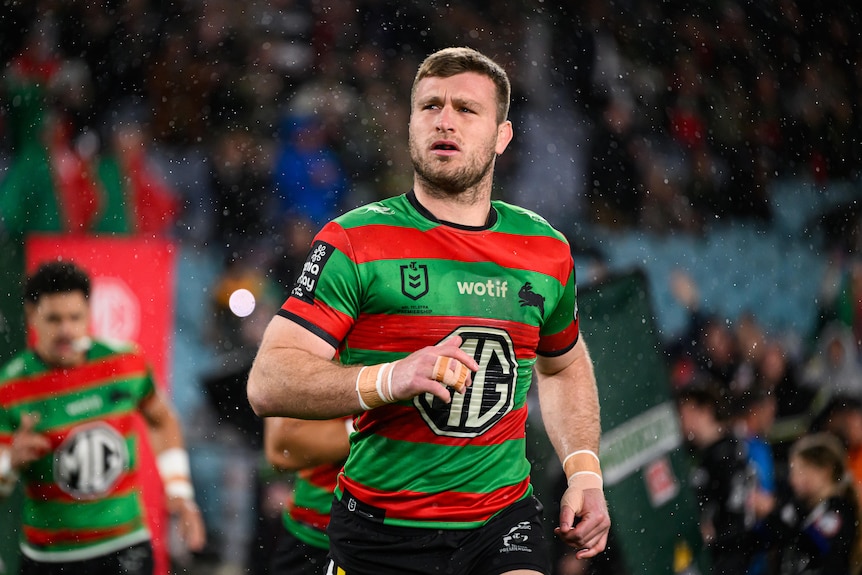
Jai Arrow says he is “ready to fight” the disease. (AAP: James Gourley)
Sporadic MND, which accounts for about 90 per cent of all cases, is thought to be triggered by environmental factors, says Dominic Rowe, professor of neurology in the Macquarie Medical School.
These include exposure to chemicals like insecticides, pesticides, fungicides and herbicides.
“If you live in rural or regional Australia, you are 40 per cent more likely to die from MND compared to if you live in the city, and we think that’s related to the billions of dollars of chemicals we have thrown into our environment,” Dr Rowe tells ABC Gold Coast Mornings.
“These chemicals are especially designed to kill special cells like motor neurons.”
Genetics plays a part too, with about one in 10 cases classified as “familial MND”, according to Health Direct.
In Australia, two people are diagnosed with MND and two people die from the disease every day.
About 2,500 Australians are affected at any one time.
Early signs of MND
Before he died, Webb spoke to Fox League in September 2023 and revealed he went for a check-up after struggling to do menial tasks.
“Just struggling to button up my shirt, holding a dinner plate and a cup to go back to the table for a meal,” he said.
“Initially I just thought it could be a back injury or something spinal, I’ll go check that out. Then I couldn’t even do 10 push ups, and strength had always been a big part of my game so I thought, ‘That’s really odd.'”
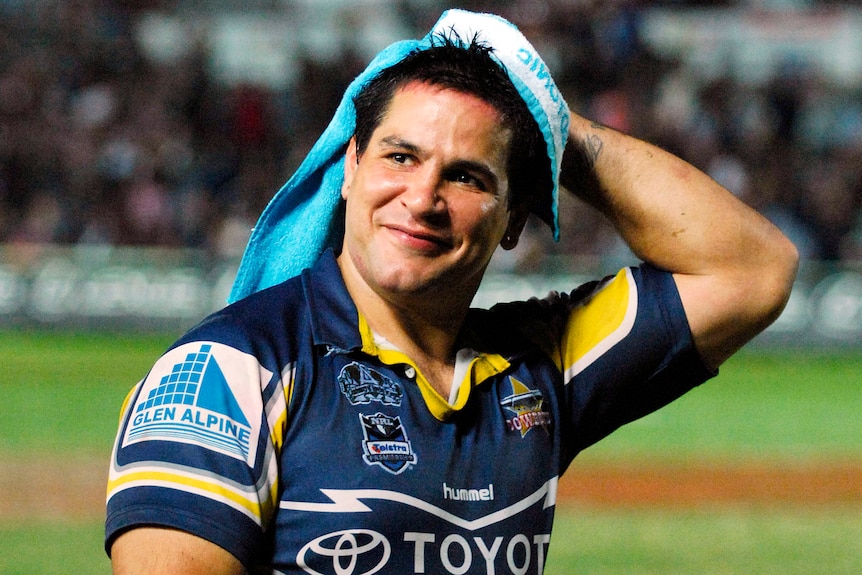
Australian rugby league forward Carl Webb passed away aged 42 in December 2023. (Getty Images: Ian Hitchcock)
In an interview with the BBC, Borrows describes being a “prisoner in my own body”.
“The lights are on, but no-one’s home. I think like you, but my mind doesn’t work right. I can’t move my body.“
Another suspected risk factor for MND is head injury, which is common in contact sports like rugby league, rugby union, AFL and soccer.
While some studies show a link between professional players of high-impact sports and the development of MND, the Motor Neurone Disease Association is cautious about drawing a link between the two.
“There is not enough evidence to show there is a strong link,” a post says on the website.
Dr Steyn agrees.
“There is evidence that repeated head impacts and traumatic brain injury are associated with increased risk of some neurodegenerative conditions.
“However, the specific relationship between head injury and MND remains uncertain and needs ongoing research.”
What lies ahead for Arrow?
There is no current cure for MND and no specific test either.
Life expectancy after being diagnosed with MND is one to five years, but it can vary from person to person.
An estimated 10 per cent of people living with the disease survive for 10 years or more.
“Prognosis depends on the type of MND, the pattern of symptoms, the rate of progression, respiratory involvement, nutritional status, age, access to multidisciplinary care, and individual biological factors that we still do not fully understand,” Dr Steyn says.
However, treatments are available to help lessen the impact on a person’s quality of life.
These include:
- Riluzole, a medication that can slightly slow down the progression of the condition
- Medicines to relieve muscle stiffness and help with saliva problems
- Physiotherapy
- Speech therapy
- Occupational therapy
- Advice from dietitians
When asked what the future looks like for him, he has a defiant message.
“To fight,” he says.
“I wanted to do this to let people know I am OK and I am ready to fight.
“Nothing is going to take me out easy. I want to do everything I can, any trial, any medication that will maintain me for as long as I can.”
Dr Steyn says while Arrow has been “dealt a very difficult hand”, he also has some “very powerful cards”.
“His family, friends, community, clinical team, and the broader MND community,” he says.
“My experience is that the MND community is forward-facing.
“It is a community that looks for solutions, supports one another, and works hard to lift people up through an incredibly difficult diagnosis.”
Dr Rowe also says while the spotlight is currently on Arrow, as it was on Webb and Daniher, the “catastrophe around its impact on every family dealing with the diagnosis should not be underestimated”.
NRL fans call for special round
Fans have called on the NRL to introduce an MND round, just like the AFL has done since 2015.
In posts and comments on social media, fans said they want to raise awareness of the disease and help fund research to combat it.
“The NRL should do a round to fundraise for MND research this year given Jai Arrow’s diagnosis, with Carl Webb fresh in the minds of many too,” one fan wrote.
“Global MND Awareness Day is June 21st. Super League/Championship and the NRL should make the closest round to that date an MND Round to fundraise for MND research,” another wrote.
Daniher is the driving force behind the AFL’s MND Day, which centres around the Big Freeze at the ‘G’ match.
dan