


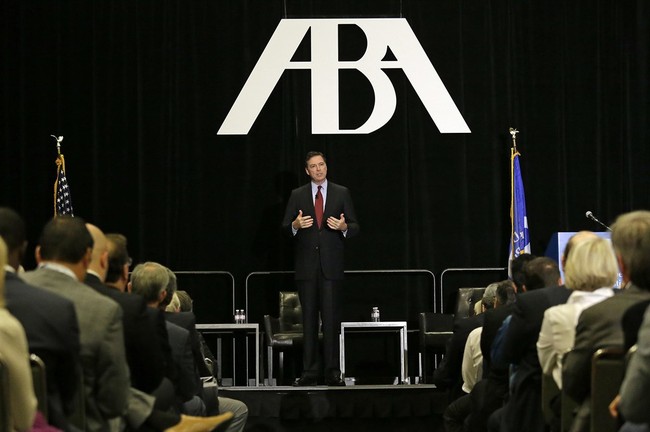
The American Bar Association blinked. After years of using its stranglehold on law school accreditation to mandate DEI ideology across American legal education, the lawyers’ guild voted Friday to repeal its core diversity standard — not because it wanted to, but because it had no choice.
Advertisement
The vote targeted Standard 206, the rule that required law schools to demonstrate a “commitment to diversity and inclusion” across admissions, recruitment, and student programming. It had been suspended since February 2025, but suspension wasn’t enough — the Trump administration wanted it gone. The repeal still must clear the ABA’s House of Delegates, a process that could drag into 2027.
Make no mistake: This is a remarkable retreat for an organization that has spent decades leveraging accreditation power to steer the legal profession leftward. The ABA controls which law schools are legitimate, which standards they must meet, and ultimately who enters the profession. That’s an enormous amount of institutional power, and it has been wielded with a clear ideological agenda for a very long time.
Read More: Attorney General Bondi Kicks American Bar Association to the Curb
DOJ: UCLA Med School Caught Using Illegal Race-Based Admissions
The breaking point came when President Trump signed an executive order directing Education Secretary Linda McMahon to review whether the ABA should continue serving as the federal government’s official law school accreditor at all. The order didn’t mince words, citing the ABA’s “unlawful ‘diversity, equity, and inclusion’ requirements” as the justification. For an organization whose entire institutional authority rests on that federal recognition, it was an existential warning shot.
States didn’t wait for the ABA to clean up its act. Texas, Florida, and Alabama have already taken concrete steps to break its dominance over attorney licensing. Tennessee and Ohio are reportedly weighing similar moves.
Advertisement
Even some ABA council members were candid about why the vote happened: It wasn’t a change of heart, it was a survival calculation.
“Even though I personally agree with [the diversity and inclusion standard] and what it tries to achieve, I think it’s appropriate as an accrediting body that we eliminate that standard so we don’t inhibit the diversity of ideas out there in various types of legal education environments,” said council member David Brennen.
Translation: The ABA still believes in what it was doing. It just can’t afford to keep doing it openly.
The ABA Journal reported that the accrediting council is also facing an ongoing Department of Education review that could determine whether it keeps its status as the nation’s sole federally recognized accreditor for law schools. An internal standards committee memo laid out the reality in plain terms.
The national system of accreditation—and the Council’s role as an accreditor—would be imminently threatened if the diversity and inclusion rule is not repealed.
Even as the ABA retreats on paper, the ideology isn’t going anywhere quietly. A report last month flagged that Standard 303(c), which requires law schools to teach students about “bias, cross cultural competency and racism” before graduation, was left untouched when the ABA first suspended Standard 206.
Worse, a report from the conservative nonprofit Defending Education found that as of April 2026, 72 law schools across 24 states still maintain DEI programs, many of them simply rebranded under softer names. Villanova calls its DEI page “Unitas: Community Building.” The University of Colorado, Boulder, went with “Community and Culture.” American University’s DEI office is now the “Office of Inclusive Excellence and Leadership Development.” Iowa’s Drake University opted for “Collaborative Culture.”
Advertisement
The names changed. The ideology didn’t.
The ABA council voted Friday to also seek public comment on eliminating Standard 303(c), along with other DEI-related rules tied to cultural competency and non-discrimination requirements.
The Department of Education’s reaccreditation hearing is scheduled for September. Standard 303(c) remains in place for now, and more Republican-led states are weighing whether to follow Texas, Florida, and Alabama in loosening ties with the ABA.
The ABA spent decades building a monopoly over who gets to become a lawyer in this country. Now, that monopoly is under threat from the White House, the Department of Education, and a growing list of states that are done playing along. The fight over who controls legal education in America is just beginning.
Editor’s Note: Do you enjoy RedState’s conservative reporting that takes on the radical left and woke media? Support our work so that we can continue to bring you the truth.
Join RedState VIP and use promo code FIGHT to receive 60% off your membership.