


As US President Donald Trump attempts to sway security policy in Latin America and the Caribbean, a new report found that confrontations between security forces and criminal groups are on the rise, and criminal groups are adapting.
The report, published on May 27 by Armed Conflict Location & Event Data (ACLED)—a non-profit organization dedicated to the collection and mapping of data on violence around the world—seeks to quantify how the so-called “Donroe Doctrine,” or the Trump administration’s efforts to assert US dominance and shape policy in Latin America and the Caribbean, has impacted governments’ approaches to their own security issues.
Since Trump took office in January 2025, the United States has prioritized military action against drug trafficking organizations and used combative social media posts making threats of military intervention and economic sanctions to pressure the region’s governments into aligning with his security agenda.
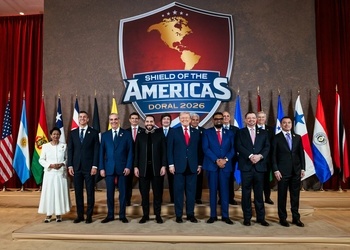
In March, Trump gathered 12 regional leaders in Miami for the “Shield of the Americas” summit, where they committed to working together to “eradicate the criminal cartels” with force. Notably absent were Colombia, Mexico, and Brazil, home to the region’s most powerful organized crime groups and perhaps the three most important regional players in the United States’ war on drugs and organized crime.
The alliance was an extension of the lethal airstrikes the US military began conducting in September 2025 against alleged drug trafficking boats in the Caribbean and Pacific. More than 200 people have been killed in more than 60 of these strikes so far, which human rights organizations have called “extrajudicial killings.”
Here, we explore ACLED’s findings and what they tell us about the new era of anti-crime policy under Trump.
Confrontations More Frequent, Lethal
Trump’s security strategy has created an environment in Latin America and the Caribbean that encourages lethal confrontations between security forces and criminal groups, the report found.
ACLED’s event monitoring tracked an 18% uptick in clashes between security forces and armed groups in Latin America and the Caribbean in 2025. These operations resulted in at least 6,900 deaths, the highest total ACLED has recorded since 2018.
Authorities in Guatemala, Trinidad & Tobago, and Jamaica, all of which have signed on to the Shield of the Americas initiative, clashed with armed groups nearly twice as often in 2025, and deaths in those clashes also skyrocketed. Ecuador, another Shield of the Americas member that has conducted airstrikes against alleged organized crime targets with US assistance, saw the number of confrontations drop slightly from 225 in 2024 to 212 in 2025. However, deaths in these clashes jumped from 111 to 135.
SEE ALSO: Did US Military Strikes Impact Caribbean Drug Trafficking?
This increase is the result of a “climate of impunity” that is a direct result of “[Trump’s] apparent disregard for international law and human rights standards,” the report claimed. Still, even countries not aligned with Trump’s security agenda have seen upticks in confrontations and their lethality.
In Colombia, the government has gradually abandoned negotiations with various criminal factions since 2024 as part of its “Total Peace” initiative. Clashes between security forces and armed groups have proliferated as a result. In 2025, as the Trump administration and President Gustavo Petro clashed over the latter’s security record, ACLED recorded 890 clashes resulting in 542 deaths, up from 351 killed in 517 confrontations in 2024.
Meanwhile, Mexican President Claudia Sheinbaum has turned away from her predecessor’s “hugs not bullets” security strategy and adopted a more confrontational stance against crime groups, both in response to pressure domestically and from Trump. As a result, confrontations between security forces and criminal groups in Mexico jumped to 1,068 in 2025, up from 844 in 2024. Fatalities in these events also rose to 871 from 802.
“When it comes to progressive governments, the room for maneuver is reduced by Trump’s pressure,” Tiziano Breda, a senior analyst at ACLED and one of the report’s authors, told InSight Crime. “It’s very visible in Mexico because there’s been a lot of pressure on Sheinbaum to step up operations, deploy the national guard at the border, and to show results to avoid tariffs and unilateral operations.”
Crime Groups Adapt
Amid government attempts to use overwhelming force, the report found that criminal groups have both adapted and fragmented, casting doubt over official claims of progress.
For example, despite US backing of Ecuador’s military-centered approach to tackling organized crime, the country was Latin America’s most violent in 2025. The government’s focus on attacking the leaders of criminal groups has produced power vacuums resulting in more violence between and within gangs. Ecuador’s criminal groups have also become more resilient, tapping into illegal mining, extortion, and other revenue streams. Meanwhile, leaders have moved abroad and continue to direct operations in Ecuador out of the reach of authorities.
SEE ALSO: InSight Crime’s 2025 Homicide Round-Up
One of the main ways groups have adapted, however, is through the use of drones, the report added.
“It could be that criminal groups are seeking to maintain a low profile, and being able to rely on drones exposes those criminal groups way less,” said Sandra Pellegrini, a senior analyst at ACLED and another author of the report. “We see them being used as part of criminal competitions, gang-on-gang clashes, or the targeting of civilians.”
ACLED also found that with the rise of drones, criminal groups are increasingly using them to attack security forces. Cases of this happening in Mexico grew more than 600% between 2023 and 2025. Similarly, in Colombia, armed groups used drones to attack security forces 107 times in 2025, compared to just once in 2023.
Featured image: US President Donald Trump poses with Latin American and Caribbean leaders at the Shield of the Americas summit. (Credit: The White House)