


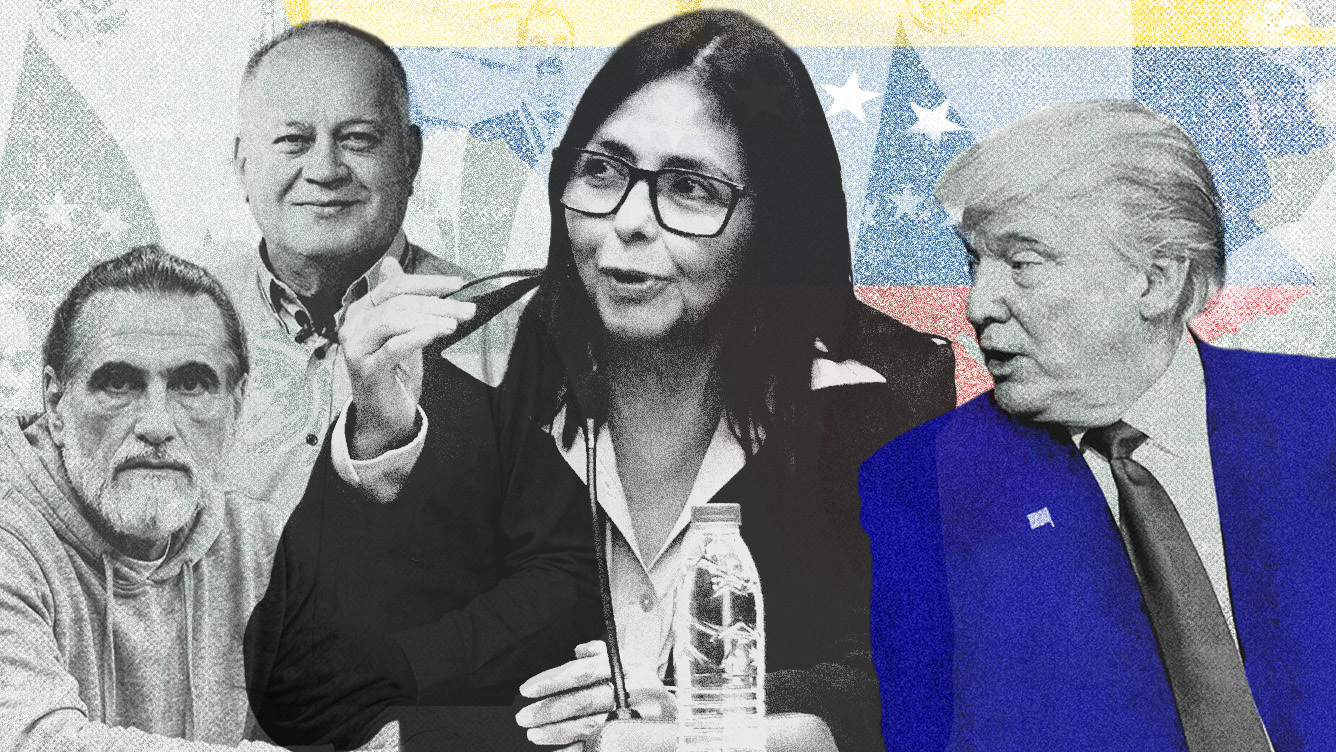
Since the capture and extradition of Nicolás Maduro in early January by United States military forces, Venezuelan interim President Delcy Rodríguez has been trying to balance the demands of her US overlords with those of her criminal alliances that have kept her party in power for years.
The job is not easy. While US President Donald Trump has yet to demand democratic elections, his administration has made clear that it expects cooperation from Rodríguez’s government on security and counternarcotics issues, as well as a more business-friendly environment.
And, for their part, Rodríguez and her administration have adopted a series of security measures aimed at keeping US pressure and demands at bay. Still, she must also preserve the support of key domestic allies, among them members of the so-called Cartel of the Suns, a loose network of criminals embedded in the government’s most important institutions.
Below, InSight Crime assesses how well Rodríguez is doing to address the core issues contributing to organized crime in Venezuela.
Political Purge of Maduro-Linked Figures
At the surface, the purge of top-level criminal actors appears under way. The most significant of these was Alex Saab, Maduro’s alleged financial frontman, who was deported to the United States on May 16 to face money laundering charges. The case underscores Rodríguez’s apparent willingness to break with Maduro’s inner circle while also clearing the political landscape of figures sought by Washington.
Saab served as a key financial operator for Maduro and allegedly led a sprawling network of corruption, money laundering, and sanctions evasion tied to multiple sectors of the Venezuelan economy, from the oil industry to gold mining, according to US court filings and investigative reporting.
The businessman was arrested in Cape Verde in 2020 and extradited to the United States during the first Trump administration. However, he was released in 2023 after receiving clemency from then-President Joe Biden in exchange for the release of US detainees held in Venezuela, a decision that drew strong criticism from Trump and Republican allies. Upon returning to Venezuela, Saab was appointed to a cabinet post, which he held until his dismissal shortly after Maduro’s arrest in 2026.
Since February, according to press reports, Saab had remained in custody under Venezuelan security forces allegedly working in coordination with US agencies. Other high-profile businessmen linked to Maduro have also reportedly been questioned or temporarily detained by Venezuelan authorities, potentially signaling broader investigations into corruption tied to the former administration, although the extent of US involvement in these operations remains unclear.
Still, no other major arrests of top criminal figures working within the government or closely with the government have been announced since. Chief among these alleged criminals is Interior Minister Diosdado Cabello. Cabello has been one of the most powerful figures within the government for decades and has long been tied to the Cartel of the Suns.
He is also accused by US authorities of involvement in drug trafficking and is wanted in connection with the same drug trafficking case against Maduro. But so far, he seems to be immune to any prosecution. To be sure, he is leading a purge of the police.
Alleged Police Purge Over Corruption
Ironically, it was Cabello who announced in April that more than 12,000 police officers had been dismissed for allegedly participating in acts of corruption, many of them linked to extortion schemes, as part of what authorities described as a broader purge of Venezuela’s security apparatus.
The minister provided few details about the alleged purge, including the timeframe in which the dismissals occurred, the security bodies involved, or the judicial and disciplinary measures taken against the officers. The lack of transparency, and Cabello’s own criminal history, has undermined the credibility of the initiative and made it difficult to independently assess its scope.
Based on academic estimates suggesting Venezuela had roughly 175,000 security personnel in 2017, the reported dismissals would amount to around 7% of the country’s police force. But corruption within the security apparatus is rooted in deeper structural dynamics that were consolidated under Maduro and helped enable what InSight Crime has described as a “hybrid state”—a system in which state actors and organized crime networks operate symbiotically for mutual benefit.
SEE ALSO: Cocaine and Venezuela’s Cartel of the Suns Post-Maduro
Military Reshuffle
In March, Rodríguez removed former Defense Minister Vladimir Padrino López and replaced him with intelligence chief Gustavo González López. The move marked the most significant shift in the military hierarchy since Maduro’s arrest. However, details surrounding the broader reconfiguration of military command structures across the country remain opaque, and so far the reshuffle does not appear to have produced systemic changes to the climate of impunity or the involvement of military officers in organized crime.
To date, González López’s decisions have pointed to what appears to be a reduction in the overt politicization of the armed forces. One of his first measures was reportedly to withdraw military officers who had been assigned as security details for politicians or placed in civilian government posts—a notable departure from practices institutionalized under Chavismo. Beyond that, however, few substantive changes have been made public.
The appointment of González López has itself drawn heavy criticism. The general previously led Venezuela’s intelligence apparatus, including the Bolivarian National Intelligence Service (Servicio Bolivariano de Inteligencia Nacional – SEBIN), agencies widely accused by international organizations and human rights groups of arbitrary detentions, torture, and political persecution. González López has also been sanctioned by the United States and the European Union over alleged human rights violations.
Prisoner Releases and Amnesty Measures
The government of Delcy Rodríguez initially released hundreds of political prisoners—at least 626 detainees in the early phase of the transition—as part of a broader amnesty initiative. However, the implementation of the measure has been widely criticized for failing to fully clear criminal charges against a significant number of those released, many of whom remain under legal restrictions or in detention, with continued allegations of torture in custody.
Human Rights Watch has described the implementation of the amnesty law as deficient, documenting cases in which individuals identified as political prisoners were excluded from its benefits or denied release altogether. Families of detainees have also reported that judicial officials in some cases demanded bribes in US dollars to process release requests.The Rodríguez administration has claimed that the amnesty process has benefited thousands of individuals, but the rollout has lacked transparency. Authorities have not published a full list of beneficiaries, and officials have suggested that the implementation phase may be nearing completion. Despite repeated calls from the Trump administration for the unconditional release of all political prisoners, the non-governmental organization Foro Penal still recorded at least 454 individuals detained for political reasons as of May 11.
SEE ALSO: Peace Never Had a Chance: Colombia’s ELN in Venezuela
Security and Intelligence Cooperation with Colombia
Venezuela and Colombia agreed to share intelligence and coordinate security forces to combat drug trafficking and smuggling in April, prioritizing border regions like Catatumbo due to the presence of armed groups there.
But there is little trust in Venezuela’s security forces, which remains a major obstacle to progress against drug trafficking, especially on the border with Colombia, the world’s biggest cocaine producer.
In addition to its institutional ties with the Cartel of the Suns, Venezuela’s military has collaborated with armed groups such as the National Liberation Army (Ejército de Liberación Nacional – ELN) on the border.