




The United Nations has finally published its data on coca cultivation in Colombia in 2024, as drug crop plantations expanded, yet concentrated in certain territories, offering the incoming president opportunities as he vows to restart eradication on an industrial scale.
The United Nations Office on Drug and Crime (UNODC) and the Colombian government registered 261,000 hectares of coca in 2024, representing a 3.5% increase compared to 2023. The report was published 18 months later than expected due to arguments over methodology with current Colombian President Gustavo Petro. The president had challenged findings that suggested cocaine production had increased as much as 53% between 2023 and 2024. As a result, the report left out possible cocaine production for the first time in more than two decades of reporting and only published data on coca cultivation.
SEE ALSO: US Pressures Colombia With Threat of Anti-Drug Aid Cuts
“Cultivation with a much more industrialized profile persists, as does the dynamic of ‘enclaves,’” Amado de Andrés, the UNODC’s representative in Colombia, told national newspaper El Tiempo. “That growth of just 3.5% year-over-year does not mean the entire phenomenon has remained stable. What happened was that the increases recorded in enclave zones offset the reductions observed outside those enclaves,” he noted.
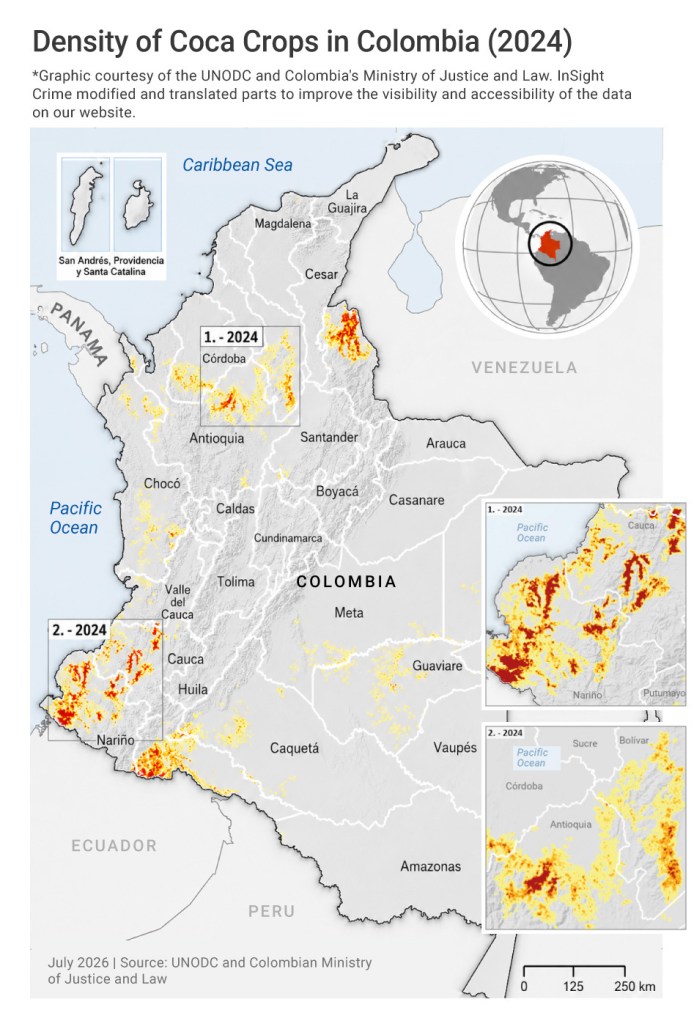
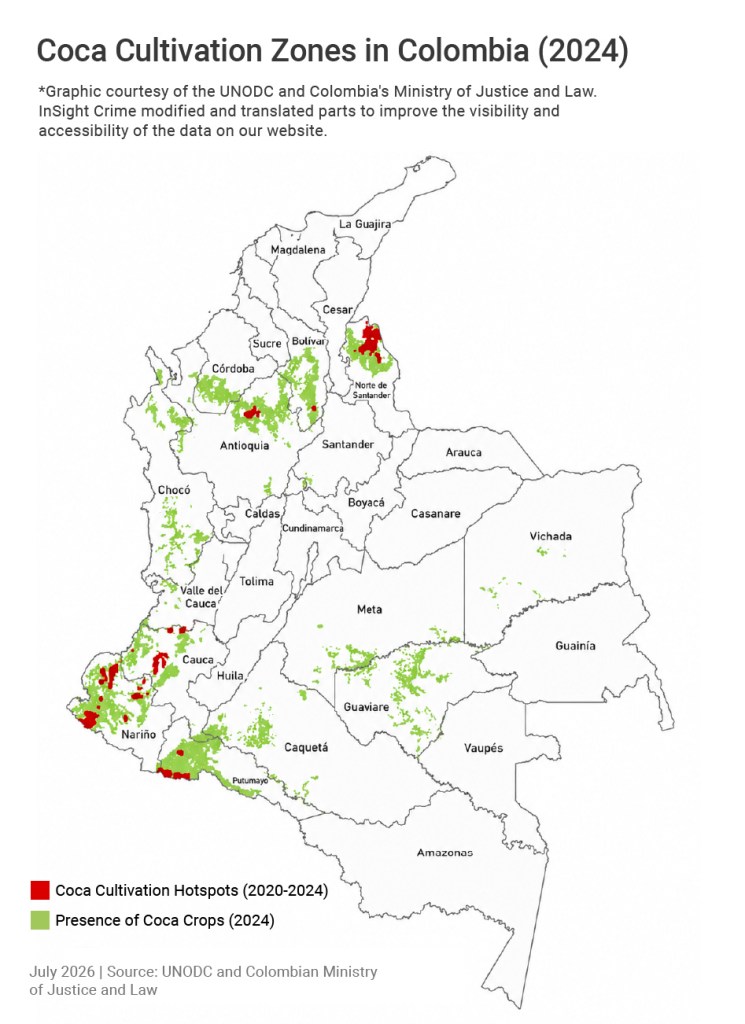
The report indicated that coca crops are increasingly concentrated in specific areas of the country, or enclaves. This dynamic is not new. It has been gradually evolving since 2012. Forty seven percent of coca crops are now concentrated in just 10 municipalities across four of Colombia’s 32 departments: Nariño, Cauca, Norte de Santander, and Putumayo.
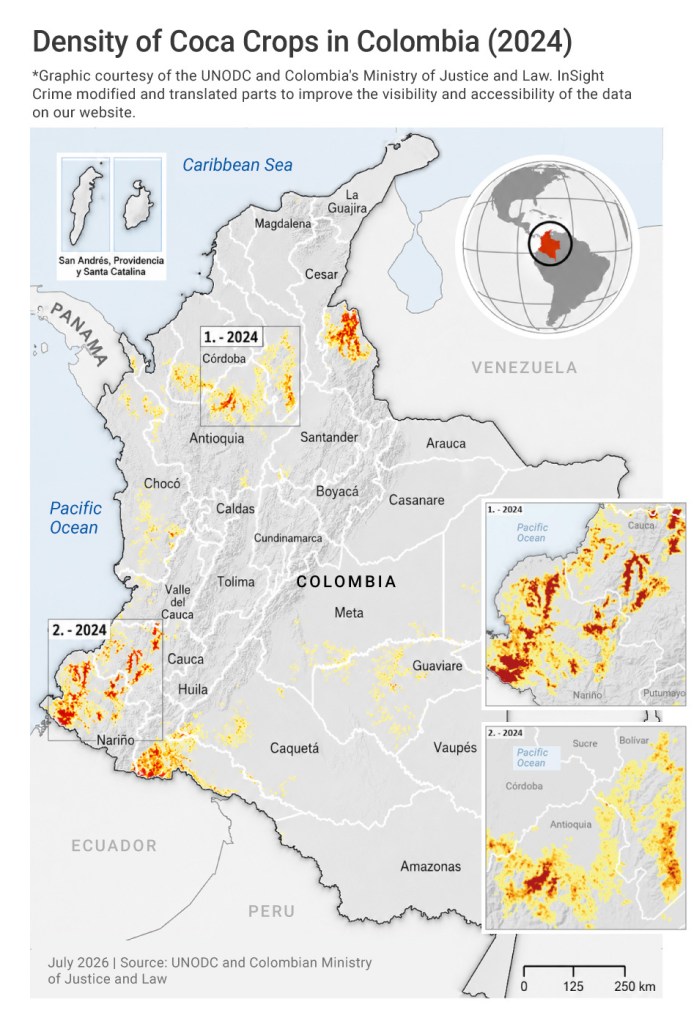
Nariño, located on the border with Ecuador, remains the country’s primary coca enclave with 74,547 hectares, an increase of more than 9,550 hectares compared to 2023. The municipality of Tumaco alone accounts for 31,300 hectares of coca. Meanwhile, Norte de Santander department on the border with Venezuela rose to second place with 48,739 hectares, concentrated mainly in the municipality of Tibú. Putumayo registered 44,473 hectares, while Cauca had 36,876.
Nariño, located on the border with Ecuador, remains the country’s primary coca enclave with 74,547 hectares, an increase of more than 9,550 hectares compared to 2023. The municipality of Tumaco alone accounts for 31,300 hectares of coca. Meanwhile, Norte de Santander department on the border with Venezuela rose to second place with 48,739 hectares, concentrated mainly in the municipality of Tibú. Putumayo registered 44,473 hectares, while Cauca had 36,876.
What Does This Mean for Colombia’s Next Government?
The fact that the majority of coca cultivation is concentrated in just 10 municipalities provides president-elect Abelardo De la Espriella, who takes office in August, with clear targets for his aerial eradication campaign, which was one of his main campaign pledges. He has the chance to remove almost half of the sourcing for Colombia’s cocaine production in short order. But while this sounds simple, it is not.
SEE ALSO: Two Extremes: The Security Choices Facing Colombian Voters
Coca eradication has been central to Colombia’s US-sponsored drug policy since the start of Plan Colombia in 2000. Before 2015, Colombia’s coca eradication program was built around aerial eradication. This entailed crop dusting aircraft flying above coca fields and spraying glyphosate chemicals, which killed all plant life in the target area. That approach was suspended by the National Narcotics Council (Consejo Nacional de Estupefacientes – CNE) in 2015, and later by the courts, as possibly harmful to humans.
De la Espriella is proposing to use drones and bioherbicides to tackle the sea of coca. He faces legal challenges in implementing this measure. On one hand, he must meet requirements set by the Constitutional Court to ensure that the resumption of aerial spraying does not violate community rights; on the other, he must secure authorizations from the CNE and obtain environmental licenses, among other requirements.
“The challenge is, in particular, a legal one: seeing how the incoming government interprets the Constitutional Court’s orders and how the court enforces its own jurisprudence regarding whether to permit or halt fumigation,” said Paula Aguirre, the director of a Colombian civil society organization named Elementa.
Legal challenges are not the only obstacles. While Colombia’s anti-narcotics police have been experimenting with the use of drones for eradication, there is not a drone fleet waiting and ready to start the process. A suitable drone model needs to be approved, then made or purchased in sufficient quantities to enable any large-scale eradication campaign. This will take time and money.
The 10 municipalities where coca is most concentrated are also strongholds for illegal armed groups, which are not simply going to allow drone operators to wander in and start their work. Just like they did not allow manual eradicators in the past. Some of the illegal actors, like the National Liberation Army (Ejército de Liberación Nacional – ELN) guerrillas, have been fighting for 60 years and resisted everything the US-backed Colombian military has thrown at them. They are stronger today than ever before in their history, in no small part thanks to the drug trade. A series of major military operations will be needed in criminal strongholds to ensure that eradication can move ahead.
Recycling Past Experiences
Everything De la Espriella is proposing has been done before. What the current administration of Gustavo Petro, a former left-wing guerrilla, has done is the outlier. Upon taking office in 2022, Petro offered a new approach to fighting the drug trade and the criminal actors that manage it. He vowed to reduce coca eradication, which had been at the center of US-backed Colombian security policy for two decades, because it punished coca-growing farmers, the weakest and least lucrative link in the drug chain. Instead, he vowed to target the upper ends of the drug business, drug barons, international brokers, and corrupt officials that protected them. And then he promised to make peace with—and demobilize—the illegal armies that run the trade in an ambitious strategy dubbed Total Peace (Paz Total).
SEE ALSO: The Opportunities and Pitfalls of Colombia’s Ambitious New Drug Policy
It was a bold plan that failed. Coca crops continued to grow, and the illegal armies talked peace while expanding into new territories to gain access to more coca, control movement corridors within the country, and secure departure points for cocaine shipments. As Petro prepares to hand over power to De la Espriella next month, the cocaine trade is more prolific and more globalized than it has ever been.
Even if De la Espriella is able to push ahead with his mass eradication program, he will be unlikely to rival the 172,000 hectares eradicated by crop-dusting planes in 2006, or even the record 130,000 hectares reportedly eradicated by the administration of Iván Duque (2018-2022) in 2020 using manual eradication. Coca crops actually expanded during the Duque administration, even despite that level of eradication.
What’s more, the number of hectares under cultivation is not a reliable indicator of the amount of cocaine being produced. The yield of kilograms of cocaine per hectare of coca continues to rise. In 2000, when Plan Colombia and the eradication campaign began, InSight Crime field research in Putumayo revealed the average yield was four kilograms per year, spread over two to three harvests. Today, employing new strains of coca, better care of the land and coca bushes, up to six harvests a year, better techniques of extracting the alkaloid from the leaves, and more sophisticated laboratory techniques for purifying and crystalizing the cocaine, the yields can exceed 10 kilograms per hectare.
Under the pressure of both aerial and manual eradication, drug traffickers adapted quickly to minimize losses. In the days of aerial spraying, traffickers quickly realized that the planes needed big, visible targets. The farmers adapted by shrinking the sizes of their fields to less than three hectares and sowing coca alongside plantain, palm trees, or coffee bushes to disguise the drug crops. When manual eradication gathered pace, the illegal armies would mobilize the civilian population against the eradication teams to prevent them from working.
“It is a cycle where the same strategies are repeatedly tried; they reduce the crops, but not significantly and only for a short time,” Aguirre told InSight Crime.
“Later, when you check, the crop is no longer there—it has moved to a neighboring municipality, the agricultural frontier has expanded, or planting is taking place in natural parks or protected areas. It is an endless cycle, with no attempt to understand the true causes behind the proliferation of these crops,” she added.