


On July 25, 2025, bursts of gunfire disrupted the usual calm in La Fría, a town in the Venezuelan state of Táchira, just a few kilometers from the border with Colombia. Citizens recorded a black truck carrying armed men, some in civilian clothes and others in Venezuelan military uniforms, shooting at another vehicle.
The confrontation was unusual because the National Liberation Army (Ejército de Liberación Nacional – ELN) maintains strong control over La Fría and much of Táchira’s border with Colombia. Venezuelan authorities usually leave the group alone, suggesting the shootout may have been a case of mistaken identity.

*This article is the fourth in a five-part investigation, “Peace Never Had a Chance: Colombia’s ELN in Venezuela,” analyzing the growth of the ELN in Venezuela and how this has allowed the rebel group to project itself into Colombia. Read the full investigation here.
Although the authorities said they detained six guerrillas, they were not publicly identified. The security forces did not comment further on the matter. Táchira Governor Freddy Bernal downplayed the incident, attributing it to a car theft gang.
The ELN has controlled La Fría for about six years, since it worked with Venezuelan security forces to expel Colombian paramilitary groups that had previously dominated the area.
The guerrillas’ presence and their subsequent consolidation were made possible through a symbiotic relationship with the Venezuelan state, in a model of hybrid criminal governance that is being replicated all along the Colombian border.
The ELN’s impunity in Táchira is the result of years of complicity and cooperation with local security forces and pro-government leaders. In many areas, the ELN has gained such profound social control that citizens view the group as an extension of the state – perhaps even more reliable than President Nicolás Maduro’s government, both socially and economically.
From Rivals to Comrades
The ELN’s relationship with Bernal has been central to its consolidation of power in Táchira.
In the mid-2010s, right-wing Colombian paramilitary groups, particularly the Rastrojos, began attempting to violently assert control over Venezuelan border communities, aiming to control lucrative smuggling routes that used clandestine border paths known as trochas – which became heavily trafficked due to the closure of official border crossings amid a breakdown in relations between Colombia and Venezuela.
At the time, Táchira was a bastion of the political opposition to Maduro’s government. In 2018, Maduro appointed Bernal, a former police officer and pro-government politician, as “protector” of Táchira – a position created to place pro-government politicians as alternative authorities in opposition-dominated states. Bernal used his post to lead a campaign to displace the paramilitaries, finding a reliable ally in the ELN.
The alliance has proven fruitful for Bernal, who officially became the governor of Táchira in 2021. The ELN has helped capture and maintain order in the once porous and chaotic border, while regulating the multiple criminal and informal economies that operate in the binational corridor. They might also have tipped the scales in Bernal’s election as governor, limiting opposition room for maneuver and pushing voters to vote for Bernal.
With its conquest of Táchira, the ELN gained criminal hegemony over a significant portion of the northern border with Colombia and the main crossing point between the two nations. And the experience taught the group the importance of combining Venezuelan authorities’ protection with strict social control, in order to maintain its hold over binational criminal economies, such as smuggling and drug trafficking.
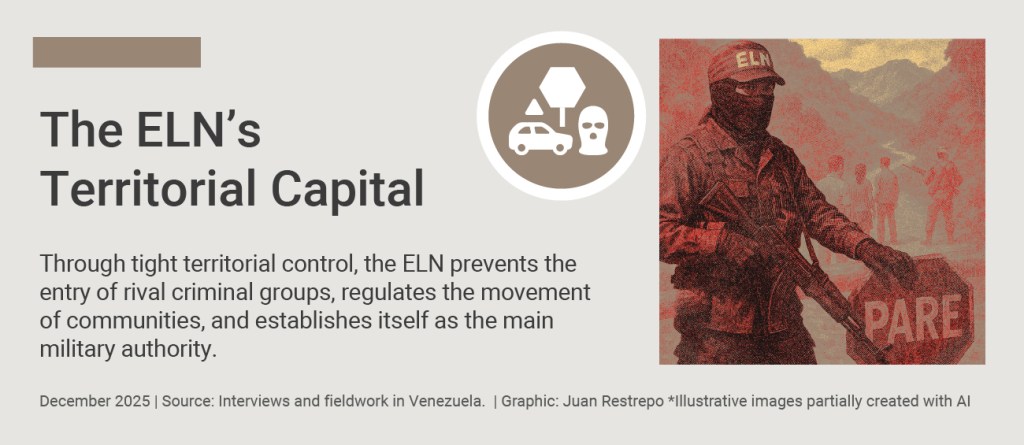
Hybrid State and Paramilitary
The ELN’s relationship with Venezuelan authorities is largely symbiotic, though occasionally complicated by communication failures or disobedience.
Official functions like border and territorial protection have tacitly been ceded to the rebels, both in Táchira and in other states along the Colombian border, where InSight Crime has observed similar patterns.
The ELN has also assumed other state functions. Officials from four municipalities, interviewed by InSight Crime under conditions of anonymity, said they coordinate activities with the guerrillas. Requests for machinery and fuel during shortages, for example, have been common, as well as requests to open roads in mountain villages, where government agencies have difficulty reaching.
The ELN also uses the profits of its illicit activities to purchase political capital.
“They send [money] for paint, for gifts, for pruning, for cutting. I mean, all those needs that public institutions have,” a municipal public official from Táchira told InSight Crime.
The ELN has imposed a set of rules in border towns that residents say have been effective in maintaining order and security, which the authorities sometimes fail to reinforce. For example, the guerrillas typically punish alleged thieves harshly, with some even disappearing.
SEE ALSO: Rebels and Paramilitaries: Colombia’s Guerrillas in Venezuela
They also sanction unacceptable public behavior, like fighting, by forcing aggressors to do community work, such as cleaning streets and roads. Additionally, they exercise parallel justice functions, resolving personal disputes and collecting unpaid debts.
Some residents support the strict social codes the ELN enforces. A merchant from La Fría told InSight Crime he is grateful to the guerrillas for improving the town’s abandoned areas, cleaning the streets, and reducing common crimes.
“We’re here fighting, surviving, and we’ve learned to live with these things that aren’t normal,” he said.
On several occasions, residents reported that security forces themselves have redirected complaints to the ELN, arguing that the guerrillas are better at resolving these conflicts than they are.
“There are people who feel safer with them [the ELN] than with the police forces,” a former political leader on the border told InSight Crime.
The Transformation of the Trochas
The ELN’s hard-won control over Táchira’s clandestine border crossings paid significant returns until recent years, when the trochas have become less lucrative due to the reopening of official entry points in September 2022, after seven years of restrictions.
However, on the Venezuelan side, the ELN’s deep infiltration of politics and the economy has allowed it to adapt its methods along with the changing landscape. The guerrillas have started extorting legal export-import businesses, according to politicians and residents of San Antonio del Táchira interviewed by InSight Crime.
The ELN “charges in a very covert manner; it has a presence in the warehouses,” commented one resident with knowledge of the customs sector. “I understand that it was 100,000 Colombian pesos [$25] per truck, and if you add up the number that crosses daily or monthly, it’s a sum that can be significant.”
During the first quarter of 2025, 4,553 cargo vehicles crossed the bridges, according to official figures. If even a small percentage of trucks pay the fee, the ELN could earn several thousand dollars per month from the extortion.

At the same time, the ELN continues to regulate the dwindling smuggling through the trochas and the passage of those who, due to lack of paperwork or movement of illegal goods, prefer to avoid legal crossings. Many companies importing Colombian goods into Venezuela, looking to avoid paying customs duties, pass trucks through the trochas, paying the guerrillas for passage. However, directly paying corrupt Venezuelan officials at official crossings may be more economical.
Binational Group
The growing influence of the ELN in Venezuelan border communities has meant that the guerrilla group, born in Colombia, has been increasingly recruiting Venezuelan nationals as well as Colombians.
Recruitment of Venezuelans is not new nor unique to Táchira. Other states, including Apure and Zulia, have also seen recruitment by the ELN, who offer good pay, clothes, cell phones, and even training.
Many young men and women in rural areas face high economic vulnerability. In 2024, the Venezuelan Finance Observatory estimated that 86% of Venezuelan households lived in poverty. In this context, the promises made by the insurgent group are particularly attractive.
SEE ALSO: Venezuela, Colombia, and the ELN at the Crossroads of Peace
The pool of available candidates in Venezuela could be making a significant impact on the ELN’s operations in Colombia.
Colombian Defense Minister Pedro Sánchez said in an interview with Caracol in August that nearly 40% of the ELN members in the Colombian Catatumbo region are foreigners, most of them Venezuelans.
The increasing share of Venezuelans making up the ELN’s membership on both sides of the border, combined with its increasing strength on Venezuelan soil, further positions the group as a binational criminal group.
“For me, the ELN today is a Colombian-Venezuelan organization,” said Luis Eduardo Celis, one of Colombia’s longest serving and most reliable analysts of the ELN.
With a strong foothold in Venezuela, backed not only by authorities at every level but also shielded by local communities, the ELN has solid ground on which to stand, take refuge, and thrive, regardless of the changes or persecution it may face on the Colombian side. The binational nature of the Colombian rebel group now shifts the security dynamics irreversibly. On both sides of the frontier.