


The first body was found in the morning. The man had been shot and killed. His hands and feet had been tied. By the evening, at least eight more were dead. By the next afternoon, as many as 12 more bodies had been recovered, and by the end of the day, the toll had reached 22.
The wave of murders over a two-day period in Ciudad Juárez between July 9 and 10 was dubbed “Red Thursday,” and for the authorities InSight Crime asked about the violence, there was a simple answer: The criminal groups were fighting over local drug markets, specifically the methamphetamine trade.
But it was not the only violent spasm in recent months in the region, which remains one of the most important criminal corridors in the country. On the outskirts of Juárez and beyond, there were also troubling signs: skirmishes between criminal factions, more bodies, and threatening messages scribbled on cardboard. And in the larger scheme of things, the fighting appeared to be a reflection of a criminal terrain in flux, one in which an old criminal guard was being replaced amid a changing criminal economy.
A New Criminal Map
If you ask most Juarenses, “the war” began in 2008. The Sinaloa Cartel, taking advantage of schisms in the Juárez Cartel, launched an assault on the city. Their first target was the local police, who they correctly believed were the core of the Juárez Cartel’s military wing, La Línea. Later targets included the Barrio Azteca, a powerful prison gang and another key Juárez Cartel ally.
The next few years were a blur of bloody battles and bodies on the streets. Between 2008 and 2011, over 10,000 people were killed in what the media, academics, and non-governmental organizations (NGOs) began calling the “murder capital of the world.” In addition to the criminal organizations, whose ranks swelled to well over 10,000 on the streets and the city’s prison, over 7,000 federal police and military forces joined the fray, scrambling the criminal map.
By 2013, violence was down fivefold from its peak in 2010, and most experts were declaring the Sinaloa Cartel the “winners.” But that pax mafiosa did not hold. By the mid-2010s, the violence began to creep up again, and while it did not reach its 2010-levels, it pushed Juárez to the top of the country’s most violent municipalities list, where it has remained ever since.
Authorities blame the recent violence on the dispute over the methamphetamine market. When InSight Crime asked Municipal Security Secretary César Omar Muñoz how he knew the murders were related to local drug peddling, he said the information came directly from several of the suspected murderers who his team had interviewed. Chihuahua state Security Minister Gilberto Loya corroborated this analysis with what he said was his own first-hand information. The analysis also corresponded with what InSight Crime heard repeatedly from NGOs that monitor security in the city.
However, the motive gets fuzzier closer to the ground. While much of the violence is concentrated in areas where methamphetamine is sold or consumed, it does not appear to be related to one group trying to take another group’s territory to sell the drug. Instead, one group appears to be singularly focused on suppressing the sale and consumption of methamphetamine and maintaining territorial control in their areas of influence.
That group is La Línea, the same group that was the armed wing of the Juárez Cartel. It has few of the core members it had during the war with the Sinaloa Cartel, but it has largely replaced the Juárez Cartel as the dominant force in the city, along with its ally, the Barrio Azteca.
The reasons it is trying to suppress the sale and consumption of methamphetamine are many, according to the above-mentioned officials and NGO sources. For one, La Línea does not have widespread access to methamphetamine. The same sources also said La Línea believes that methamphetamine use leads to more social problems, which draws more attention from authorities, thus hurting business. And it destroys their client base faster than other drugs, such as heroin, which users can consume for decades.
Indeed, heroin – along with cocaine, crack, and marijuana – is permitted in territory dominated by La Línea and its local associates, among them the Barrio Azteca. This includes downtown along the border with the United States and stretching to the main nightlife district and more affluent neighborhoods to the east. (Cocaine, however, has largely been displaced by methamphetamine, another reason La Línea may be so adamant about suppressing that market.)

Meanwhile, the southern and southwestern edge of the city along the border, where most of the recent murders have taken place, are controlled by the Sinaloa Cartel and its local associates, the Artistas Asesinos (Artists Assassins). The homicide trend centered on this area goes back years, one local NGO that monitors security told InSight Crime, which the group says reinforces the analysis that violence and microtrafficking are intimately related to this effort by La Línea and its allies to suppress methamphetamine consumption.
Still, local drug peddling is but one criminal economy in dispute. What’s more, these traditional criminal alliances in Juárez appear to be in flux.
A Migrant Boom and a New Player
In recent years, Juárez became a key corridor for migrant smuggling to the United States. Profits soared to rival those of drug trafficking, which dramatically altered the criminal economy. What’s more, in both Mexico and the United States, human smuggling crimes were not pursued, much less prosecuted, as vigorously as drug trafficking, which made it even more appealing.
The first large Juárez criminal group to realize it could make millions with relatively little risk was the Mexicles. During the war, the Mexicles had sided with the Sinaloa Cartel, and for years, the group has had a formidable presence in the city’s prison, a key operational headquarters for Juárez criminals.
By the early 2020s, following their jailed leader, Ernesto Alfredo Piñón de la Cruz, alias “El Neto,” they were freelancing, doing their own businesses apart from the Sinaloa Cartel. Most importantly, they took control of local smuggling and began charging between $5,000 and $10,000 to bring people to the United States, Loya told InSight Crime. They also kidnapped scores of migrants and extorted them for ransom, he added.
The returns were astronomical. Chihuahua state government analysts estimated the Juárez human smuggling market alone generated as much as $100 million per month. And Loya said that for a time, human smuggling was more lucrative than international drug trafficking in Juárez. What’s more, they further reduced the already low legal jeopardy by employing scores of minors to work as polleros, or human smugglers, crossing small groups into the United States, where they were rarely prosecuted.
For their part, the Mexicles used their earnings to expand. In an area southeast of the city along the US border, they formed the Mexicle Independent Criminal Organization (Organización Criminal Independiente Mexicle – OCIM). Security Minister Loya said they first got wind of the new faction after US authorities reported to them that a criminal group calling themselves OCIM-50 had hijacked five trucks of a prominent company headed to the municipal border crossing.
In an effort to dilute the Mexicles’ rising power, the Chihuahua state government decided to transfer dozens of key Mexicles members, among them Neto, to other state prisons. The Mexicles quickly responded to the threat. In August 2022, the Mexicles staged a riot inside and outside the prison in a failed bid to escape. “Black Thursday,” as it was called, left 11 dead. On January 1, 2023, they tried again, and this time, Neto escaped along with 30 others. Seventeen people were killed, among them guards, prisoners, and civilians. But in the days that followed, police tracked most of the prisoners down, including Neto, who was shot dead in Juárez, according to authorities.
By then, a new group calling itself La Empresa, loosely translated as The Enterprise, had emerged. The Enterprise’s origins are murky. Juárez Security Secretary Muñoz said it was a breakaway group from the Barrio Azteca; Chihuahua Security Secretary Loya said it was a breakaway from La Línea, and perhaps even a construct of the old members of the Juárez Cartel who were worried La Línea was completely cutting them out of the business.
Notably, the Enterprise’s leader, according to Loya, is Gerardo Santana, alias “300.” Up until the late 2010s, Santana was described as the leader of the Barrio Azteca, and, according to Border Report, the US Federal Bureau of Investigation (FBI) has said that former leaders of the gang created the Enterprise.
What is clear is that, as the Mexicles power waned, the Enterprise took over a good portion of the human smuggling industry, expanding their purview in the historical corridor for the lucrative criminal market and squeezing what was left of the Barrio Azteca, which had traditionally controlled this area, into a small section of the city. Some of the violence on Red Thursday happened in areas under their purview. They also teamed up with the Mexicles to attack the Artists Assassins in the southern part of the city, Loya said. And like their counterparts, they beefed up their presence in the local prison.
Following the inauguration of the new US President Donald Trump, human smuggling ground to a halt, but the Enterprise and others kept working, trying other businesses. Among them was kidnapping, which briefly jumped in April and May, as idle soldiers of the Enterprise and other criminal groups sought to make up the lost revenue and keep their criminal structures intact. But after a series of arrests, the Enterprise appears to be turning back to local drug peddling and may be taking aim at the biggest prize of them all: control of the Juárez international drug corridor.
The Battle Spreads in Chihuahua
It was 2024 when Chihuahua authorities realized they had another problem. On September 8 and 9, six people were killed in different parts of the Ojinaga Triangle, which includes the border towns of Ojinaga, Manuel Benavides, and Coyame. In the days that followed, authorities captured seven suspects, one of whom told them he was from Durango, according to Loya, which sits about 800 kilometers away.
The information was an ominous sign that a wider cartel war was breaking out in the state. The big players were similar: La Línea versus the Sinaloa Cartel. But behind those names were the new factions. In a later message left with the bodies of 11 subsequent murder victims in the same area, La Línea would dub itself the New Juárez Cartel (Nuevo Cártel de Juárez).
The faction of the Sinaloa Cartel was identified as “Los Cabrera.” Loya said they were members of the Cabrera Sarabia clan, a powerful family with political and criminal connections based in Durango, which the US Treasury Department designated as kingpins in 2015. Their goal, Loya said, was to establish routes for smuggling both drugs and humans through Ojinaga.
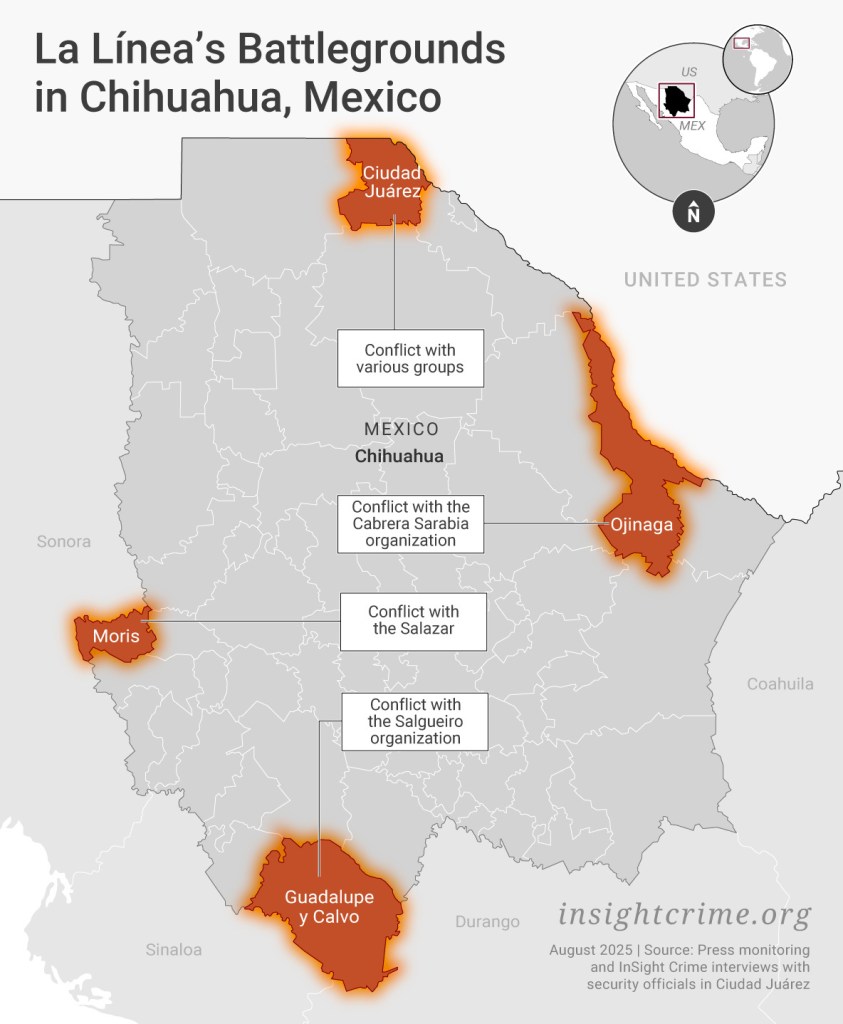
But La Línea is pushing back. In addition to the 11 bodies it left near Ojinaga, in January the group executed attacks on rival positions in Guadalupe y Calvo, a municipality in the far southern part of Chihuahua.
The tit-for-tat may spread even further afield. In July, another clan-faction of the Sinaloa Cartel known as the Salazar reportedly attacked La Línea in Moris, a municipality in the far western part of the state, using drones.
Back in Juárez, there is concern the Cabrera are seeking allies to try to penetrate the city and secure yet another criminal corridor. Authorities said that among their potential allies are the Artists Assassins. Along with the Enterprise and La Línea, the battle lines are being drawn for another war in Juárez, which would be about a lot more than the local methamphetamine market.
*Additional reporting by Victoria Dittmar.