


Cultivation of coca for cocaine production continued to spread to new municipalities in Honduras in 2024, suggesting that what may have started as an experiment is now an established business.
Honduran security forces detected and destroyed coca in 16 municipalities, up from nine in 2023, marking a record high. The number of raids against coca cultivations also spiked at 81, up from 29 in 2023, though the area of land where coca was discovered fell slightly to 461 hectares, according to data from the armed forces.
SEE ALSO: Central America Primed for Coca Expansion, Study Finds
The seizure data suggests a fragmentation of coca cultivation in the country, with smaller plots grown in more locations. But the data only tracks the coca that was discovered, which likely represents just a fraction of the total number of coca-growing municipalities and hectares of coca in the country.

Brisk seizures continued in the first six weeks of 2025, with the military reporting a further 11 raids, the destruction of almost a quarter of a million coca plants, and the discovery of nine drug laboratories. In recent years, the crop has gained footholds in the departments of Atlántida, Yoro, and Santa Barbara, with cultivations even discovered in the far west of the country on the mountainous border with Guatemala.
The remote locations of coca plantations make them difficult to detect, a security analyst, who requested anonymity because they were not authorized to talk to the press, told InSight Crime.
Anti-drug intelligence units deploy in areas where drugs are cultivated, but the Honduran armed forces do not have the same capacity to detect coca as larger coca producers like Colombia, the analyst said.
“The territory is immense and mountainous. It can’t all be controlled,” the analyst added.
Beyond Experimentation
The rapid expansion of coca throughout Honduras suggests that drug traffickers have moved beyond experimentation to establish small but commercially successful operations that could prove tricky to eradicate.
The crop was first detected in Honduras in May 2018, triggering alarms that drug trafficking groups, who have long moved drug shipments through Central America, could be attempting to transform the country into a cocaine producer. At that first raid, the security forces destroyed four hectares in Esquipulas del Norte, a rural municipality in Olancho, and observed that the crop seemed to have been modified to better adapt to local climatic conditions.
Since then, coca has spread rapidly through Honduras, though members of the security forces have consistently claimed that the cultivations in the country are experiments, and that coca is harder to grow and of poorer quality than the crops found in South America.
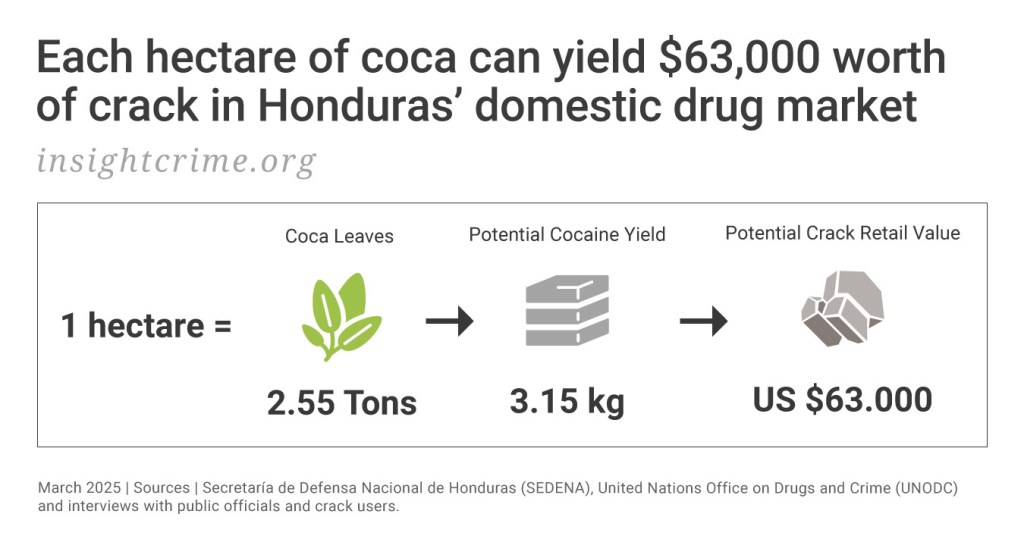
On average, one hectare of coca in Honduras can produce around 2,550 kilograms of dry leaves per year, according to a government official consulted by InSight Crime. For comparison, Colombian yields are 6,400 kilograms per hectare, according to the latest public estimates by the United Nations Office on Drugs and Crime (UNODC).
But a 2024 study published in the journal Environmental Research Letters found that as much as 47% of northern Central America had conditions apt for the cultivation of coca. The authors speculated that growing coca in Central America would be financially advantageous for drug traffickers due to the shorter distance between the supply centers and the major consumer market of the United States.
The United States has a military presence in Honduras, though the country’ flourishing coca industry is viewed by US institutions as a “local” problem, according to the security analyst.
“The United States makes a lot of demands, but their participation in the fight against coca is minimal,” the analyst said.
Growing Production and Consumption
Efforts to strangle early coca production experiments in Colón and Olancho, the departments where the plant was first detected, seem to have backfired, pushing cultivators to grow in new regions of the country further from the reach of the security forces. But the two regions remain a hotbed for coca, accounting for about two-thirds of coca seizures in 2024. Both departments are predominantly rural, fall on a key drug trafficking corridor, and consistently register the country’s highest homicide rates.
They are also strongholds for powerful criminal organizations like the Montes Bobadilla Clan, one of two criminal groups prosecutors have linked to coca production in Honduras. Since their founding as an offshoot of Colombia’s Cali Cartel, the group has blossomed into one of the country’s most successful drug trafficking organizations.
Although the coca industry appears to be expanding, drug production remains rudimentary. Drug labs attached to the cultivation areas themselves remain “rustic” and designed only to process coca leaves into cocaine paste, according to the government official, who said criminal groups in Guatemala and Mexico crystallize the paste into the final product, cocaine hydrochloride.
There is no definitive evidence of laboratories capable of producing powder cocaine operating in Honduras, Guatemala, or Mexico, but residents and members of the security forces have speculated about their existence in Honduras, and there are growing signs that the country is developing its own lucrative consumer market for cocaine.
Gangs “cook coca to make crack rocks, even close to the police station,” a community leader in one city told InSight Crime. “Crack consumption in the area is rising very fast.”
A crack rock costs 50 lempiras ($2 USD) in Honduras, according to crack users consulted by InSight Crime, and there are about 10 rocks to a gram. The figures, combined with data obtained from public authorities, suggest that each hectare of coca cultivation in Honduras could fetch up to $63,000 on domestic drug markets.
Seizures of crack have steadily increased over the last decade, potentially reflecting a spike in domestic demand. Honduran security forces seized 4.3 kilograms of crack in 2023, up from just a few grams in 2014.