


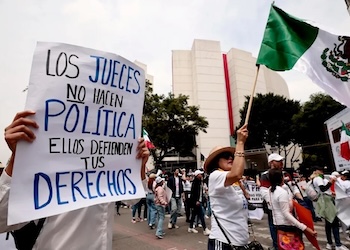
Voters in Mexico will head to the polls to select a new Supreme Court and hundreds of local and federal judges, raising questions about how this new process may impact a justice system already struggling to combat organized crime groups.
After approving the major reform last year, Mexican citizens will cast their votes on June 1 for 881 federal judicial positions, including nine Supreme Court justices, and hundreds more state and local judges. Replacements for the other half of federal judges will be voted on in 2027.
Originally promoted by former President Andrés Manuel López Obrador and his National Regeneration Movement (Movimiento de Regeneración Nacional – Morena) party, the reform has been deeply polarizing. Experts consulted by InSight Crime raised concerns that, rather than improving anti-crime efforts, the reform’s underlying objective is to align judicial decisions and legal standards with partisan politics, ultimately undermining judicial autonomy.
“These elections politicize judges, so instead of improving their legitimacy, it actually undermines it,” said Laurence Pantin, director of the Fair Trial (Juicio Justo) civil society group and an expert on Mexico’s justice system.
SEE ALSO: Popular Election of Judges in Mexico: Risk of Corruption and Inefficiency
What’s more, several of the more than 2,600 candidates fighting to secure one of these positions have been accused of links to organized crime groups. In Chihuahua, one contender previously defended Joaquín Guzmán Loera, the now jailed former Sinaloa Cartel capo known as “El Chapo.” Another faced weapons charges and advised the legal team defending various leaders of the once-feared Zetas, and another federal nominee was convicted of smuggling methamphetamine into the United States.
The former US Ambassador to Mexico, Ken Salazar, criticized the lack of strict eligibility requirements and said the popular election “would not address judicial corruption [or] strengthen the judicial branch of government.” Proponents of the change, on the other hand, argued it will help curb nepotism, increase accountability, and give citizens greater control over those interpreting the constitution.
Few countries in the region have experimented with popular judicial elections, but those that have have encountered problems. In Bolivia, for example, voters struggled with a lack of knowledge about the hundreds of candidates running for judicial positions, and the reforms did not curtail corruption as intended, but may have instead fomented misconduct.
InSight Crime Analysis
The criminal justice system in Mexico has for many years failed to successfully prosecute members of organized crime groups and keep those individuals behind bars, and it is unlikely that the popular vote of judges will do anything to address the root causes of that issue.
Arguably the most pressing problem is the near-total rate of impunity, especially in organized crime-related cases. The judicial reform does not help attack the underlying factors that hinder effective prosecutions, such as a lack of resources, funding, and specialized training.
“In the Mexican criminal justice system, judges are not the primary target of corruption,” said David Shirk, director of the Justice in Mexico program at the University of San Diego.
“Historically we’ve seen lots of infiltration and corruption within the prosecutor’s office, so it hasn’t been necessary to corrupt the judges because if you can corrupt the prosecutors, you don’t need to get to that stage,” Shirk told InSight Crime.
SEE ALSO: InDepth Coverage of Judicial Reform
That said, the popular election of judges does open up a new door for organized crime groups to try and influence the judicial process in Mexico. Removing hundreds of sitting judges and replacing them with others who have less experience in the judicial sector means that there will likely be a steep and prolonged learning curve in a system that is already underfunded, making them more susceptible to corruption.
“Instead of this reform allowing us to combat impunity, expand access to justice, or combat organized crime [in Mexico], what it’s going to do is weaken the judiciary,” said Pantin, the judicial expert.
And while this cycle has not yet seen the type of political violence commonly deployed by criminal groups and other power brokers to leverage elections, Pantin said that may be temporary due to the strict limitations on campaigning and a general lack of knowledge about those running.
The targeted violence may come later after those elected take office.
“If they make rulings that are opposed to the interests of drug traffickers, or if they start working with one organized crime group to the detriment of another, I think that’s when we would likely see violence,” Shirk told InSight Crime.
“It opens a new door for organized crime to try to influence the judicial process, and we don’t know what happens when we walk through that door,” he added.
Featured image: Voters in Mexico protest the judicial reform that led to the popular election of all judges. Credit: Telemundo