


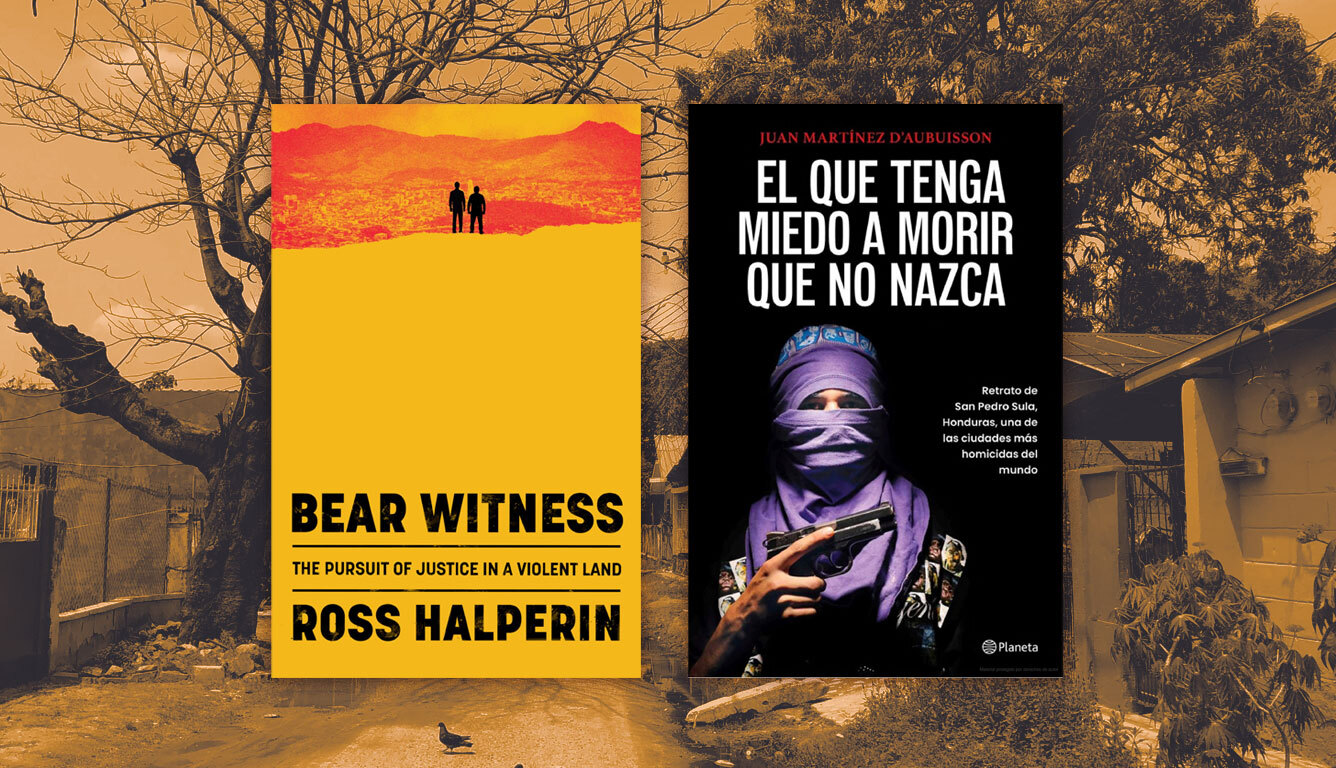
Two recent books about Honduras tackle an age-old question: At what point does the quest for justice cross ethical and possibly even legal lines and become villainous itself? Neither book offers a definitive answer, but each presents a framework for understanding what drives this quest in Honduras, and the limitations, pitfalls, and possible cynical ploys of those who lead it.
This question is at the center of “Bear Witness: The Pursuit of Justice in a Violent Land,” by Ross Halperin, a breathtaking account of one of the most ambitious civil society projects in recent memory: the Association for a More Just Society (Asociación para una Sociedad más Justa – ASJ).
And to a lesser extent, it features in “He Who’s Afraid to Die Shouldn’t Be Born,”(El que tenga miedo a morir que no nazca), Juan José Martínez’s d’Aubuisson’s dystopian profile of San Pedro Sula, the country’s industrial hub and criminal epicenter.
For his part, Halperin rightly focuses his book on ASJ’s founders and co-leaders, Kurt Ver Beek and Carlos Hernández, as the two staunchly evangelical activists wade into the criminal morass that has left Honduras reeling for decades. InSight Crime has worked with ASJ on numerous occasions, and I know Kurt and Carlos well on a personal level, so I have seen some of these projects from the inside.
Among them is a ground-level operation to find and secure witnesses against hyper-violent street gangs and vigilante groups that, over more than a decade, has shown remarkable success in jailing criminals and lowering the homicide rates in the areas where they have operated. But the ethical and legal quandaries they cross in achieving this success are myriad and dizzyingly complex.
Peace and Justice?
The project hinges on finding willing witnesses, securing their testimonies without compromising their identities, and seeing through the prosecution of the suspects within a highly corrupted judicial system. Eventually, ASJ adds another component: trying to reform the horrendous juvenile detention center, from which suspects and convicted criminals routinely escape.
The work begins in Ver Beek’s and Hernández’s Tegucigalpa suburb, Nueva Suyapa, in the early 2000s, where a street gang, the Puchos (the Bunch), and a vigilante group, the Encapuchados (the Hooded Ones), are terrorizing the over 30,000 inhabitants of the area. There, the “Secret Group,” as ASJ dubs it before later naming the program “Justice and Peace,” starts finding witnesses to testify, first against the gang and later against the vigilante group.
However, as it is in many criminal cases, the witnesses are not perfect. Some of them are alleged members of another vigilante group, part of which is later jailed, then released, for illegal possession of weapons and robbery in what Halperin paints as a nefarious effort to discredit them. Nonetheless, questions remain.
ASJ also does not have a witness protection program. The head of the vigilante group is murdered, allegedly by the Puchos, for testifying against them. The Puchos also kill others who they think the Secret Group is using to incarcerate them. These are civilians, who are caught in the crossfire, but their deaths weigh on Ver Beek and Hernández, who struggle to keep tabs on every part of the program.
The ASJ project runs into more problems as it deepens its relationship with a key ally, the police. The police force is hopelessly ill-prepared, crude, corrupt, and extremely violent. Halperin writes that ASJ workers witness “cops striking already apprehended suspects in the head, feet, and genitals, and cops threatening to cripple a detainee with an aluminum baseball bat.”
Ver Beek, Halperin says, responds to the abuses with “decision-tree logic.” He cannot go to internal affairs, the ASJ leader reasons, because it’s a “sham.” Denouncing the police abuse would do nothing, Ver Beek thinks, since it would get lost in a sea of human rights complaints. And doing anything to attack the police would mean the end of Peace and Justice, which means the gangs continue to kill, rape, and extort their way through the neighborhood.
“He was willing to accept that there might be some collateral damage on this quest,” Halperin writes of Ver Beek’s internal deliberations. “Instead of wallowing in shame or closing up shop, he would double-down on his mantra: ‘We have to get these guys off the streets.’”
SEE ALSO: Are US Anti-Crime Programs in Central America Working?
Halperin writes that Ver Beek’s partner, Hernández, was “on the same page.”
The embodiment of this dichotomy is ASJ’s liaison with the police. Going by the nickname “Cholo,” he is a former soldier who Halperin describes as a “walking-talking Faustian Bargain.”
“On the one hand, Cholo was dutiful, enthusiastic, competent, learned, and totally obsessed with completing his mission,” Halperin writes. “On the other, he was enigmatic, cocky, boastful, militant, and totally obsessed with completing his mission.”
Cholo accompanies the police on their missions or, depending on whether you believe his account, devises missions himself. In one instance, he and other authorities pose as health workers who are seeking to fumigate mosquitos to ward off illnesses like dengue and chikungunya. The ruse works: They find the home of the Puchos leader, who is captured shortly thereafter.
But the costs remain high. By the time Halperin interviews him, years after he has left ASJ, Cholo is boasting that he has photos of police torturing the leader of the Puchos and that they “shot him twice.” In one instance, he also describes in first-person plural about how he and the police began firing near the head of a suspect before screaming, “Tell us where the drugs and money are or we’re going to shoot you in the head.”
When Halperin asks Ver Beek about these events, Ver Beek says that he doesn’t “remember either knowing or having strong suspicions that they were abusing their power.”
In response to this, Halperin writes: “One can’t help but wonder whether back in the day, on his crusade to pacify the barrio, he shielded himself with some amount of wishful thinking and willful ignorance, because he knew deep down, either consciously or subconsciously, that defeating the Puchos required crossing lines he could never knowingly breach.”
Counter-Violence or Neo-Colonialism?
There are few things more powerful than when Juan José Martínez d’Aubuisson gets into his writing groove. And in his new book, “He Who’s Afraid to Die Shouldn’t Be Born” (El que tenga miedo a morir que no nazca), the anthropologist and award-winning, long-time InSight Crime contributor, employs his visceral style to powerful effect, blending scholarship with first-person narratives and bringing both the scenery and the characters to life in a way that few can.
The book is a dystopian vision of Honduras, specifically its industrial capital, San Pedro Sula, where savage capitalism has permeated everything from the street gangs to the evangelical churches to the presidency. More than his previous two books — “See, Hear, and Be Quiet” (Ver, oír, y callar) and “The Hollywood Kid” (El Niño de Hollywood), which he co-authored with his brother, Oscar — Martínez seems to be leaning into his inner-Eduardo Galeano, offering a poignant commentary on efforts to suppress violence and quell street gangs, which, for him, are just an extension of the US government’s century-long colonial project.
“The violence of the city grew, fed by the same fertilizer that fed the banana companies and later the maquilas: young and desperate meat,” he writes.
Specifically, he delves into the role of the United States Agency for International Development (USAID). Before President Donald Trump and his government efficiency taskmaster, Elon Musk, destroyed the US government institution in January, USAID fostered counter-gang and counter-violence programs throughout the region. (Full disclosure: InSight Crime wrote numerous diagnostic reports for many of these programs, including several in Honduras.)
SEE ALSO: Why US Aid Cuts to Central America Will Help Organized Crime
In Honduras, Martínez crosses paths with USAID programs in San Pedro Sula in 2015, a time when the city was ranked among the most violent in the world. In one instance that echoes that of Cholo’s schemes, he meets with a Honduran who had gone undercover, posing as a psychologist. Martínez says the group recruited potential informants at funerals, among other places, then gently coaxed them during their “therapy” sessions to reveal details about criminal operations in their neighborhoods.
A little bit later, Martínez meets with a neighborhood informant, which he calls “R.” R gets money from a USAID interlocutor for her sports and social programs, and each time she goes to the interlocutor’s office to pick up her organization’s check, they sit her down to be “interrogated by Americans and Hondurans” she doesn’t know. She worries, Martínez says, that she and others could be killed for being “involuntary spies and snitches.”
Martínez goes on: “Others spoke to me about developing maps, in which they were asked to draw where the gang members lived, and making lists of the names of [gang members’] relatives.”
As opposed to Halperin, Martínez does not follow up on whether these efforts led to prosecutions or, on the flip side, if they resulted in the murders of any informants, as it is of little consequence for his analysis. For Martínez, counter-violence and counter-gang programs are less about Hondurans’ well-being and more about a long-standing, colonial project to keep cheap labor in Honduras and foreign investment opportunities ripe for gringo companies.
‘Nobody Wants to Say That Out Loud’
Ver Beek had his own cynical take on international development. He thought that without justice, development projects could never be effective. That is why he and Hernández prioritized justice at ASJ. The traditional translations of Jesus’ famous Sermon on the Mount read, “Blessed are those who hunger and thirst for righteousness.” But Ver Beek preferred a version that was translated as: “Blessed are those who hunger and thirst for justice.”
Still, Ver Beek did not scoff at the US government’s efforts. In fact, ASJ later funded many of their justice initiatives with US government money. Martínez has also worked on these projects with InSight Crime. In one project in Honduras, for instance, Martínez was one of my researchers, ASJ was one of our key sources, and USAID was the funder. And I know from speaking with Martínez that he doesn’t think all these efforts were evil. Misguided, maybe, but not evil.
But is the remedy really worse than the disease? Maybe that depends on context.
“When you live outside the community, you can think about things like human rights in a more theoretical fashion,” Hernández tells Halperin at one point. “When you are inside, you justify certain things, up to a certain point … Nobody wants to say that out loud, but that is the way it is.”
I can speak to that on a personal level. After the door of my own home in Washington, DC was hit with a bullet during a gunfight between local criminal “crews,” I worked hard with my neighbors to persecute the person on our block that, we thought, was at the heart of the problem. It was of secondary concern to us that the police persecution of him was about to displace his entire family from their home, none of whom had anything to do with that violence.