


On November 9, 2024, gunmen stormed a bar in the Mexican town of Santiago de Querétaro, unleashing an indiscriminate spray of bullets from long weapons. Patrons dived under tables, knocking over bottles and napkin holders. Disco lights danced from the ceiling, illuminating the unfolding carnage with incongruous festivity.
The alleged target of the attack, a regional leader for the Jalisco Cartel New Generation (Cartel Jalisco Nueva Generación – CJNG) named Fernando González Núñez, was shot dead. Nine other revelers were killed in the crossfire. State authorities blamed a local gang called the Santa Rosa de Lima Cartel (CSRL) for the massacre and linked it to a violent conflict over fuel theft, known in Mexico as huachicol.
This is the second installment of a mini-series detailing the changing dynamics of Mexico’s multibillion-dollar fuel theft industry. Read part one here.
The dramatic display of brutality underscores how fuel theft has become a catalyst for some of Mexico’s worst violence. As huachicol has expanded into one of the country’s largest criminal economies, it has also become one of the deadliest, with citizens, police, and oil workers caught in the crosshairs.
Easy Money
Huachicol is a criminal economy particularly prone to violence. Fuel theft gangs must use force to control territory close to pipelines and other oil infrastructure in order to access fuel supplies. Turf disputes commonly spark conflicts between rival groups.
Once the territory has been secured, the potential profits from huachicol are high. Many pipelines in Mexico transport ready-to-use fuels between refineries, storage facilities, and export terminals. Unlike crude oil, criminal groups can sell stolen fuel without the need for processing it.
“Whatever you take out of those pipelines is fungible immediately,” said David Soud, a fuel theft expert at the Atlantic Council think tank. “The only barrier to entry is getting the expertise to tap the pipeline and the basic infrastructure to move the fuel. You can make money very quickly.”
SEE ALSO: High Gas Prices Make Fuel Theft Profitable in Mexico
Cash from huachicol funds the growth of criminal groups through violent territorial expansion and the development of corruption networks. Fuel theft networks routinely pay security forces to turn a blind eye, and sometimes even hire them as extra muscle. In June, for example, security forces arrested eleven members of state police in Guanajuato who worked as armed guards for a huachicol gang.
Civilians in the Crossfire
Most violence linked to fuel theft is concentrated in Mexico’s central states. These areas are close to vast tracts of the country’s pipelines, key oil infrastructure, and large population centers that provide lucrative black markets for stolen fuel. Huachicol groups attack each other to seize territory from rivals with access to the best fuel theft hotspots.
Criminal groups also unleash violence against civilian populations to sow terror and send messages to rivals. In September 2024, six people were kidnapped in the state of Puebla. Security forces eventually located their corpses, dumped in burning vehicles near the town of Santa María Xonacatepec, and attributed the violence to a conflict between two rival huachicol gangs.
In the same month, the Barredora, a fuel theft gang based in Tabasco and allegedly once headed by the state’s security chief, kidnapped local businessman César Anaya from his home in San Martín Texmelucan in Puebla. A video later surfaced on social media showing Anaya handcuffed and badly beaten, warning fuel theft groups to stay away from the area. His decapitated body was found a few days later outside a nearby Walmart.
Criminal groups have also frequently attacked oil workers and the security forces. For example, in January 2023, fuel thieves attacked members of the military and national guard who were helping employees of the state oil company Petróleos Mexicanos (Pemex) repair broken pipelines in Cuautepec de Hinojosa, the municipality in Hidalgo that has been the most targeted by huachicol gangs in recent years.
Security forces have also been accused of perpetrating extrajudicial killings themselves. On March 1, 2019, four people from the town of Santa Rita Tlahuapan were found dead and partially buried off a highway in the state of Tlaxcala. One day earlier, the victims had been detained and accused of stealing fuel by members of the Mexican navy. Twelve security officials were later charged with aggravated homicide and a Pemex employee who guided the officers claimed that they witnessed them bury the bodies. The Mexican navy claimed that the officials had acted “of their own volition.”
State Capture and the CJNG
Fuel theft is contributing to a growing security crisis in Tabasco, an oil-rich state on Mexico’s Gulf Coast that exemplifies the expansive reach of violence related to huachicol.
The expansion of the CJNG into the state has split local criminal groups; while some allied, others fought back, driving levels of violence to new highs. Between 2023 and 2024, the homicide rate spiked 260%, from 9.4 killings per 100,000 to 34.1, according to data from the Executive Secretariat of the National Public Safety System (Secretariado Ejecutivo del Sistema Nacional de Seguridad Pública – SESNSP).
SEE ALSO: CJNG’s Fuel Theft Empire in the Crosshairs of US Treasury Sanctions
High-level state officials allegedly spearheaded some of the violence. In September, authorities in Paraguay captured Hernán Bermúdez Requena, Tabasco’s security chief between 2019 and 2024. Military documents obtained and shared with journalists by the Guacamaya hacker collective in 2022 indicated that while in office, Bermúdez led the Barredora group dedicated to extortion and fuel theft. A former federal police official named Ulises Pinto, detained on July 23, was second in command.
Bermúdez used his power and the Barredora to consolidate the CJNG’s territorial grip over the state’s huachicol hotspots, including by ordering the execution of huachicol leaders working for rival groups, according to the Guacamaya documents. He also may have opened lucrative markets for fuel stolen by the group. Under his alleged leadership, the group offered 180,000 liters of illicit diesel a week to support the construction of the Maya Train, a flagship national infrastructure project championed by the government of former president Andrés Manuel López Obrador, though the deal was not completed due to logistical reasons, according to reporting by Mexican anti-corruption outfit Mexicans Against Corruption and Impunity (Mexicanos Contra la Corrupción y la Impunidad – MCCI).
In December 2023, a violent fissure erupted in the Barredora itself, causing the group to split into two; one faction allied with the CJNG, and the other started a campaign of brutal resistance. In the days that followed, Bermúdez narrowly escaped an assassination attempt and resigned from the state government. He was arrested in Paraguay and extradited to Mexico in September.
Violent Repetition
The escalation of violence in Tabasco has mirrored insecurity in other regions driven by fuel theft, like Guanajuato, where the growth of the CJNG has long spooked local criminal groups, including the CSRL.
A “war” between the CJNG and CSRL started in Guanajuato in 2017 and coincided with a quadrupling of the state’s homicide rate, which remains high today. In 2024, the state recorded 62.4 killings per 100,000, the second-highest rate in Mexico. The state is crisscrossed with Pemex pipelines and key oil infrastructure heavily targeted by criminal groups.
Huachicol fueled the CSRL’s lightning growth and funded the onslaught of violence. At its peak in 2020, the gang stole as much as 1.5% of the oil produced by Pemex, generating between $800,000 and $1.2 million a day for the group. Successive security operations against the CSRL captured leaders but have so far failed to debilitate the group, and the group is still a major driver of violence in Guanajuato.
In recent years, the CSRL, funded in part by support from groups outside the state who are also rivals to the CJNG, has ramped up their use of tactical terror against civilians as a territorial tool, according to security analyst David Saucedo.
“They don’t just kill [criminal] leaders; they also kill citizens to send a message of strength,” Saucedo told InSight Crime.
In 2024, prosecutors linked the CSRL to the assassination of Gisela Gaytán, a mayoral candidate for the Guanajuato city of Celaya, on the first day of her campaign. And in May, members of the group opened fire at attendees of a religious event in San Bartolo de Berrios, slaying six in a central square. In the hours that followed, the town was festooned with banners signed by the CSRL.
“We have arrived,” one read.
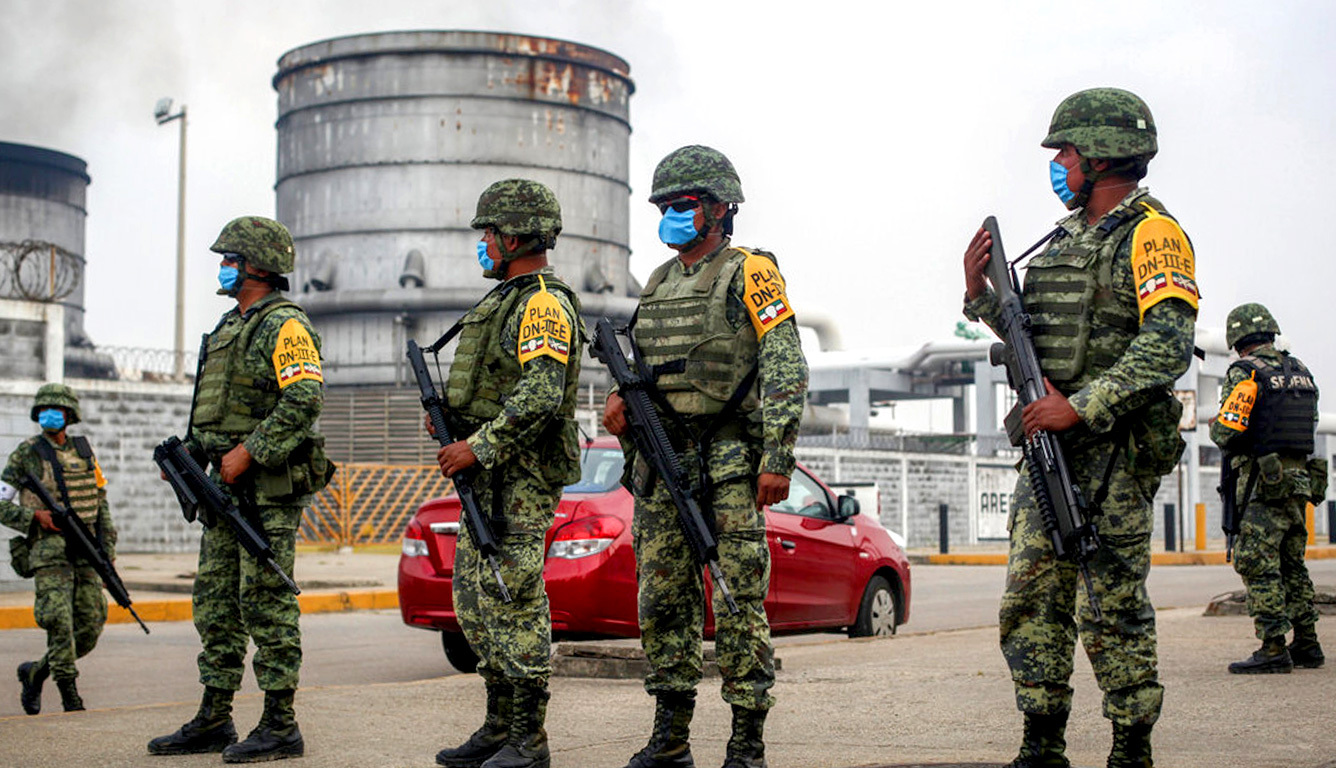
Featured image: Mexican army soldiers stand guard at an entrance of the Pajaritos petrochemical complex in Coatzacoalcos. Credit: AP